Thursday, October 20, 2016

Angkor Wat, Cambodia

A visit to Cambodia or Camobodge or Kampuchea is never complete without seeing the spectacular Angkor Wat.  It is no doubt one of the largest religious and architectural wonders of the world.

The first time I visited Angkor, I had heard it is a huge temple but never did I imagine it would be so huge and the Angkor complex would be spread for miles and miles. It was declared UNESCO Heritage Site in 1992 and almost 2 million tourist visit it every year. It has occupied the center part of the Cambodian flag since 1850 when the first flag was designed. Over a period of years, it went through many changes but Angkor wat always stood in the center.


Flag of Kingdom of Cambodia

It is also seen in their 500 Riel currency note.


With so much to write about these temples, it is not going to be just one post, I will have to write one post on each temple I visited. There is still so much to see there and each time I happen to make a visit, I come back with more insight and knowledge. Angkor can be translated to mean a "city of temples". Angkor a deviation from the word Nagara (नगर )meaning a city in Sanskrit. Wat is derived from a French name Vat meaning a temple. So Angkor Wat means "a city of temples"
I have written about Kbal Spean and floating villages earlier.

Angkor Wat is just a small segment in this huge complex

History and some facts:
  • Built by Suryavarman II in the 12th century, it took 40 years and 20, 000 workers to complete Angkor Wat. This included the moat, walls and the monument.
  • Around 5 million tons of sand stone was used for construction.
  • The stones were brought from a quarry 70 kms away, dragging them all the way by elephants or using the water way.
  • This Wat is made on a marshy land so the ground had first to be pounded manually to make the foundation strong, otherwise it would just give way.
  • The temple occupies an area of 500 acres surrounded by a laterite wall.
  • The construction started from inside towards the outside, opposite to what is usually done.
  • One surprising feature about the architecture is that no mortar has been used in construction. The huge stones are fixed in a socket joint mechanism and remain intact todate. Also, vegetable compound has been used as a sealant.
  • The Angkor Kingdom was at its zenith by the 14th century till it was attacked by Thais in 1431 and having lost soon lost its charm by 1432.
  • Though Angkor Wat was built as a Hindu temple (Vishnu), but by 12th century when Theravada Buddhism spread to the region from Sri Lanka, most of the temples became Buddhist temples.
Few facts about the deviation in architecture:
  • A temple or a wat never faces in the western direction. West is a symbolism of setting sun and death in Hinduism. It remained a mystery for some time as to why Angkor Wat faces west. It has now been accepted that it was made with the intention of using it as a funerary for the King Suryavarman II. The west facing temple supports this understanding. 
  • The bas reliefs run in anti clockwise or counterclockwise direction which is opposite to the normal norm where they run clockwise.
Cambodia had Hinduism at the time Angkor Wat was built. The deity worshipped was Vishnu, after that came Mahayana Buddhism for a short time. By mid 12th century Shaivism, which was a dominant religious sect of Hinduism, came into practice. The famous Preah Vihar is a Shiva temple. Apart from this from 780 A.D. to 800 AD, there are said to be 1000 Shiva temples constructed in that region.

Since, Suryavarman II followed Vaishnavism, worshipping Lord Vishnu dominated so he had a huge monolith state of Vishnu installed at Angkor Wat which is worshipped even today. Around 1600 A.D., Angkor became a Thervada Buddhist monument.

The temple and its architecture:
The temple is built on Brahminical philosophy where mount Meru is the center surrounded by its peak. God reside in the central tower or sanctuary. Moat denotes the cosmic ocean. 

The temple entrance is guarded by two majestic lions on either side and a seven hooded serpent. All around it is a moat. This moat is designed so that during floods the water is diverted and drained away from the temple so that it is not damaged.

naga and lion at entrance

lion

Brahma had lions at his doorway as guardians. Not only Angkor Wat but other temples too have lions at their entrance.

library, central tower and the moat

Well, what is a wat and is it different than a pagoda ? Pagodas are learning centers, meeting places in addition to place of worship.  Wat in addition to being a place of worship, having meeting rooms, place for monks to stay also have stupas containing the remains of holy people.
The body of a deceased ruler is left in state for a period of 3 months in a wat in Cambodia before it is finally cremated.

naga balustrade and moat

the gates at the rear end, moat on the side

The moat is 200 meters wide and runs all around the temple. the total length of moat is around five and half kms. The height of temple to the pinnacle of central or the main tower is said to be 213 meters. The causeway is 200 meters long made of sandstone.

If you stand across the moat, you shall see five gates.
The central gate was for entry of the Kings, on either side of this main entrance the two gates were for public servants and Commander-in-Chief and then on their either side was entrance for elephants and horses, the top of which have collapsed.

You enter through a gate and a huge monolith statue of Vishnu the preserver, erected by Suryavarman, II greets you.  Clothed in yellow robes with eight arms under an umbrella, this image is said to be protecting the monument.

Vishnu at the west gate
Devaraja (देवराजा ) cult of Hinduism was in practice where a king is not only the head of state but is also considered an embodiment of Lord Vishnu or Shiva. Hence, the image is also said to be an impersonification of King Suryavarman II.

Palm fruit, the national fruit of Cambodia lines the side of causeway. The edge of causeway is lined with a naga or serpent balustrade.

naga balustrade


Another interesting feature I found were holes in stones in the causeway. I asked my guide and he said they were made at the time when the temple was built. It made transporting stones easy by placing logs and lifting them.

Two libraries for monks stand on either side

library

But before we go inside, the first vision you get of Angkor is a central main tower surrounded by 2 smaller ones.

At the end of causeway, the naga holds its head up forming a seven-hooded canopy.


Infact, there are four small towers or prangs and one central tower forming a quincunx. This is a term which I have often used in my earlier posts on Ayutthya temples. The central and the heighest tower represents Mount Meru, with four smaller towers reprsenting continents and the moat representing the ocean

  • The height from temple ground to the pinnacle of central or the main tower is said to be 213 meters.
  • Another interesting feature is that the temple is made over 3 levels: outermost level has the least height and as the temple progresses inwards, the height too increases.
lily pond on side

in front of one of the side gates

seven hooded naga on the side, almost falling bas relief

West gopura of outer enclosure, west face of temple

east side of temple


Vishnu on pediment at entrance

broken pediment lies on ground

naga

a stupa on side, maybe it was later addition

Architecture inside the temple:
Apsaras or celestial goddesses can be seen all over the temple walls.

Apsaras on the walls

There are said to be around 1,700 apsaras adorning the walls of Angkor Wat. The most interesting feature of these apsaras is that none of the apsaras have similar crowns over their head. Each has a different one!
Putting all pictures here is not possible so I have another post for Apsaras in Angkor Wat

The famous apsara danceers of Cambodia still wear that style of head gear.

On entering, anticlockwise in the corridor is the first level or the outermost tier. It has bas reliefs which are said to be the world's longest continuous bas reliefs. No wonder it is called the gallery of bas relief. The roof throughout the temple is arched, the stones being put together without any mortar. They probably used a natural gum.
I am just giving a glimpse of bas relief, detailed bas reliefs is on another post.

The gallery is cordoned from wall to stop tourists from touching the work.

bas reliefs run from one end of the corridor to another

Before going to the second level, there is a gallery called the gallery with thousand Buddha, (Preah PoanPreah is temple and Poan is thousand in Khmer) with plenty of damaged Buddha images.


Buddha images

more Buddha images
Though Angkor Wat was built as a Hindu temple but as I have already mentioned it became a Buddhist place and continues being so. Either the images above were damaged or were a result of looting I do not know.

The corridor connects to second level.
Second level has interlacing corridors with many apsaras on walls.

a very typical bas-relief seen throughout the temple

It also gives a wonderful view of central tower which is  65 meters and is highest of all towers. It was said to be the tallest structure in the city.

Central tower


There are people dressed up .... and you can take a picture of you with them.

Apsaras on wall in the second level near central tower


Very steep iron steps lead to the third level. The elevation is at about 50 degrees!
But before that you need to be properly dressed. No short dresses including shorts and sleeveless is permitted.
There are twelve stairs representing twelve months of the year. The stairs were too steep which proved quite risky so they now have an iron stairs on top of the stone ones.

Climbing up is not that bad but coming down is very frightening especially if you vertigo. The best way is to come the way you climbed, that way you do not get to see the ground.

 a Buddha image in a corner
The top level represents heaven and only the King and high priests worshiped Lord Vishnu. Earlier, the general public did not come to this level.


corridor at the third level
view from above

reclining Buddha in the main central tower of third level

It is said that in the early days, a golden image of Vishnu stood on the shoulders of Garuda.

a morning scene with monks

lost kingdom

The view from top gives ample oppotunity to take pictures.
Retracing steps to exit, you pass through second level corridor with many more images of Buddha at corners.


an alcove with Buddha images

Buddha image in a corner

Another Buddha image

Throughout the temple, the arched roof specially caught my attention. Securing huge blocks of sandstone without any mortar using natural resins!

bas relief on top of door of corridor

bas relief of Ravana lifting Mount Kailash

the roof too has beautiful work

dancing apsaras on roof

inscription tablet

another inscription slab

Only super masters in architecture and super craftmanship could have managed to built some thing like Angkor Wat more than 800 years ago.


Tuesday, October 11, 2016

So many things to paint on!

Many a times I get into a painting momentum and start looking around my house. There are so many things a dab of paint can do to your boring and life less things.

I bought jute slippers which were dull so I decided to add some color.

a set of his and her slippers!
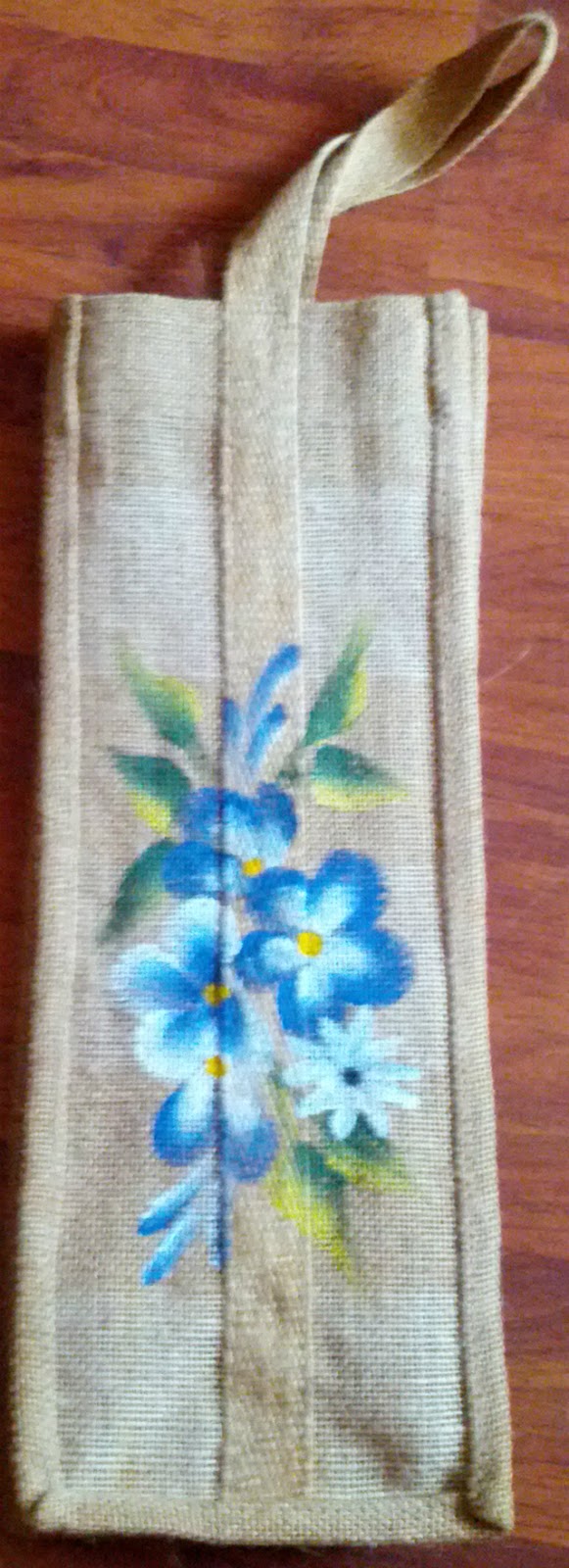
a wine bottle bag gets a face lift
The jute bags were good but looked quite plain so I painted few flowers
Bamboo steamers which can be used as small containers to store accessories on your dressing table.
 A satin box becomes an ideal gift box with few strokes of brush
 I had plenty of A4 sheets after I was over with a project. I made few tote bags adding contrasting colors and using decorative scissors.
 The addition of few flowers to the bags made them all the more beautiful.
Pocket diaries look beautiful with flowers painted. On my first trial, I painted them outside. They looked fine but I realised that the paint wiped off after frequent use. So, this time I painted on the inside of the transparent cover. This made a protective cover for the flowers.
Dainty bags became a wine bottle holder and also served as a pot pouri bag!
little spray painting on white scarves
terracotta bowls
small terracotta bowls
cork coasters
cork trivets
Photo frames
some more photo frames
wooden plaques
candles

painted soaps
I have in detail written a post on Painted soaps

How could I have forgotton my terracotta pots? I bought few pots and painted some flowers to give some color.

painted pots
There are so many around the house, go ahead and paint on them.

Tuesday, October 4, 2016

Visiting Angkor complex

When I first visited Angkor complex in 2011, I had no idea that the complex was so massive. To a visitor, it seems that it can be seen in a day. Only once you enter the complex, does one realize its vastness. I thought of first writing about the facts, a little bit of history and then cover the temples. Though, in my enthusiasm, I have already added two posts.

Facts about Angkor complex:
The Angkor complex, along with its many temples, stretches around 250 miles.
The credit of establishing Khmer kingdom goes to Jayavarman II. But, the list of rulers contributing to Angkor Kindom are many. Most of them adding some thing or the other.
Before 800 A.D., there was a struggle for power and Jayavarman II took the reign in his hands.

Background and history:
The temples in the complex were built between 800 to 1300 A.D. Around 27 kings ruled during the period. Some were more important and dominant.
Indravarman III, established the irrigation system and reservoirs called baray. If you plan to visit Banteay Srie, you would see baray on to your right. Later his son, Yasovarman I started construction of temples. The kingdom spread to Bay of Bengal on one side to Vietnam and into China, on the other.

Then came King Suryavarman II, who built Angkor Wat and dedicated the temple to Lord Vishnu. A huge statue of Vishnu still stands today. Vaishavism remained the state religion till Thervada Buddhism took over in 14-15th century. The temple complex also became the state capital of Khmer Kingdom.

The Khmer kingdom fell around 15th century and became redundant till the time it was discovered in the late 80's.

The Angkor complex is a 20 minute drive from Siem Reap, the city near the Angkor complex. Since there is no place to stay at Angkor, you have to stay at Siem Reap which is very tourist friendly. Here are plenty of places to eat, both reasonable and expensive. Night market attracts a lot of tourists. Don't miss the massage after you have walked all day at Angkor complex. Fish massage is equally joyful.


The above plan gives an insight about the size of Angkor complex

Entrance ticket:
You need to get a photo pass made at the entrance and enter the complex using this. There is a double checking for passes. You are free to move out of the complex and come back again provided you retain your ticket. The ticket also becomes your souvenir with a picture of you on it!


A one-day ticket costs $20 and covers all the temples in the complex. A two day pass is $40, a three day is also $40 and a seven day pass is $60 but you have to use it on seven consecutive days.
Guide services are available in all major languages.

After one more check that the ticket has been bought, your vehicle enters the Angkor conservation area. Look to your sides, monkeys and heavy growth of trees can be seen. Soon you start seeing small temples, lots under renovation.

There are so many temples that covering them all is only possible if you have an ardent interest in archaelogy and have a lot of time. Otherwise, visiting few major temples gives an idea about the vastness of this place.

Before you venture, decide which temples you would be visiting. I can say that in my opinion, if you are very short of time you must see the three major sites-- Angkor wat, Tha Prom, Bayon. This is usually the tour guides take you to. It would also be a good idea to squeeze in Banteay Srie in your plan, and if you have time combine Kabal Spean with it. That would give you a perspective of the architecture over a period of years.


Opening hours:
The ticket office opens early at 5:00 AM. Angkor Wat and most of the temples open at that hour. If you want to see the sunrise, go early and you get a beautiful view provided there are no clouds. Angkor Wat closes at 6:00 PM after the sun sets.
Banteay Srie closes at 5:00 PM and Kbal Spean at 3:00 PM


Sunday, September 25, 2016

Midlife Crisis

Midlife crisis. Don't we hear this word so much? Does it affect everyone and is there a way we can try to reduce its impact?
I never thought that this word would enter my world. But, what is midlife crisis?
We are so busy with our lives that we hardly get time to think of anything else other than work. Its only after there is a change in our lifestyle which is very different from our earlier routine that this depression starts setting in. It may be after retirement, children leaving home, a spouse leaving home, or getting too busy in his profession, or even a tragedy in the family. They say it affects women more and earlier than men. All this made me wonder why this would be the case. After careful introspection, I figured out that women are more entangled in the web of household and are the hub of all activities. The sudden reduction of responsibilities introduces emptiness in their lives.

I was a stay at home mother for few years after my marriage. I was thoroughly contented, looking after the home and rearing children having no time to even look at myself. I woud be free once the children start going to school, I thought, but that was not so. Once they were back from school, monitoring their studies and talking to them about school became the most important thing for me. I regressed to their mental age!

What do you do? This was something people would ask me when I would meet some one new. Do? no, I don't do anything would be my answer and they would say OOOH in a pitying way.

Being a trained teacher, I joined school after a few years. Life then became all the more hectic but it was a source of pride, an accomplishment. Now, whenever the question of what I did came about, I would proudly proclaim that I was a teacher!!

My children soon graduated from school and went off for further studies. I left school as we moved from one place to another and my husband's job required a lot of travel. I would accompany him some times.
But, when I was on my own then there was a sort of vacuum, an emptiness that started engulfing me. A feeling that everyone is busy is their lives and no one has time for me. Is this what is called midlife crisis? If so, I can't ruin my life like this. There has to be some way out.

I sat one day contemplating and thought as to what do I like? What is I would want to do? Something which I have always wanted but have put in the back of my mind giving priority to my family?
A sudden wave hit me and I said this is the time I need to give something to myself. This thought entirely changed my perspective towards life. Gone was the vacuum I was feeling.
I picked up new hobbies, learnt so many things irrespective of whether they would be useful. I just wanted to enjoy life.

Life is short, don't fret because as the saying goes, "the world laughs when you laugh but when you cry, you cry alone". People would sympathise with you but finally it is you who has to live your life.
Forget the thought of " I shouldn't be doing this or this is not my age to do this." Your are the master of your life and you run it the way you want it to. Dance on a peppy number, play games if you are in no mood to do anything else, watch a movie or tv serials. Start learning a new language. Involve yourself in some social work. All this will keep you very occupied and will give you the satifaction of doing some thing good for people. Think of it as a freedom from stereostypes.
I live in a non English speaking region, so I try to learn their language and teach some thing to them. One thing I do while watching tv is to do something with my hands. The work is more fun and you are multitasking at the same time.

Now, when someone asks me what do you do? I say you mean to ask if I work outside the home? No, I don't but I have so much to do at home that I don't have time to get bored or think of anything else.

Something I find strange is that most people assume that working outside the house is working and being a home maker is not. There is definitely a lot of strain on working mothers but for those who are stay at home moms, it may be quite monotonous. I have experienced both and can easily assess both of them. I am not going to say which is better because there are advantages in both of them. For those who are not working outside homes, say with pride that you are a home maker. Have the satisfaction of tending to your family needs. Your family is because of you and revolves around you.

It is not only women who face this crisis, it may hit them earlier but this affects men equally especially after they retire from jobs. They become irritated, depressed, lose interest in life. They repeatedly talk about when they held a particular designation or what happened and how they tackled the situation. It is imperative for men to pick up some hobbies as well. If, possible take up some part time job if you want. But, you all relax, you have done your bit. You shall never get a better time to enjoy life with your spouse or your family.

The life now looks beautiful and I look forward to the start of new day. So long as this life suits me, I am happy. If in future I start getting depressed, I might modify my engagements and change the direction of my life yet again!


Kep, the town for sea food

Kep, a small French colonial place is one of the ideal weekend get away in Cambodia. Situated in the Gulf of Thailand, the place is peaceful and is very welcome after the erratic traffic at Phnom Penh.

The place offers a wide choice for accomodation and is easily available. We decided to take a family room which had an open area with a comfortable couch and chairs outside our rooms.


In a corner was a seating place with pillows and mosquito netting.


shell light shade!


The verandah provided a beautiful view and also of the Gulf of Thailand.

We arrive for our breakfast here.

Rabbit island (Koh Tonsay):
Make a day trip to rabbit island. For this, you go to the ferry terminal.You can hire a shared motorboat or can hire a separate one. The charges are $25 per boat. They shall ask you for the time of return. Having done this you get into the boat and start your joourney. Depending on the weather, the water can be very rough. It was when we went and I could not even take any pictures.

Once at the island, the boatman might ask you for the time of return for confirmation. Take a narrow winding path to the other side of island. That is where the main activity is.

enjoying a siesta

Once there, you are greeted by white sand beach and trees under which hang hammocks. Grab a hammock and laze around. There are small eateries, order a cool drink or fresh coconut water. You get cocktails and beer at very reasonable prices.

Once back in town, try experimenting sea food by the wharf. There are plenty of restaurants serving fresh sea food.

sauteed crabs

curried prawns
These prawns have an entirely different taste. I have yet to come across a place like this in Phnom Penh which serves such tasty sea food. Added to sea food are the fresh Kampot peppercorns which lend a very typical flavor to the dish.

cockles
They were not that good and my children decided to leave half of them behind.
Returning back towards Phnom Penh, make a detour and visit a pepper farm. Most of them welcome visitors and show them around the farm.

Visit to pepper farm:
Kampot is famous for its pepper which is widely used in French cuisine. It almost vanished after Khmer Rouge. The plantations are now reviving.

pepper climbers

black, red and white peppercorns left to dry

All these peppercorns come from the same plant. First harvest is the white, they ripen a little bit and produce red and last of the crop are black peppercorns.

rambutans waiting to ripen

Phnom Chngok:
Further ahead towards Kampot a diversion towards an off beaten track leads to a network of caves. As soon as a vehicle nears the caves, children come running to be a guide for you. They are wonderful guides with torches in hand lead you to dark, narrow caves infested with mosquitoes.

a temple at entrance


The interconnecting caves, I was told was a safe haven during the Khmer Rouge days for their cadres.

entering one the caves

I was not brave enough to venture deep into any of the caves and felt happy on coming out.

The limestone hillock has subterranean water. I do not know how much is true but we were told by our child guide that earlier they could go inside but now they have snakes in water.

 entering foot of hills with stalactites of calcium carbonate deposits


Statue of Buddha under the caves


Passing through the winding path and manoeuvring through big stones I make my way outside back into the "civilization"! Or I would say to my mundane traffic packed life.