
Kathmandu valley is said to have been filled with a lake some 2,000 years back and a single lotus bloomed in it. The Bodhisattava, Manjusri emptied the water with his sword, the lotus settled where the stupa is now and formed into a stupa, hence the name Swayambhu (Swayam, self and bhu, place), a self arisen place.
This place is commonly also known as the Monkey temple as hordes of monkeys can be seen. The mythology says that Manjusri was so deep in meditation and his hair grew and soon got head lice. The lice transformed into monkeys and have been living in this area since then.
Unfortunately, like many monuments, this stupa could not escape the onslaught by Muslim invader Shamsuddin Illyas Shah of Bengal in 14th century. Suspecting lots of treasure hidden beneath the stupa, he destroyed it but found nothing. The stupa was renovated around 22 years later.
In the above picture, the Tibetan zodiac animals, ox, tiger, hare,


This place is commonly also known as the Monkey temple as hordes of monkeys can be seen. The mythology says that Manjusri was so deep in meditation and his hair grew and soon got head lice. The lice transformed into monkeys and have been living in this area since then.
Unfortunately, like many monuments, this stupa could not escape the onslaught by Muslim invader Shamsuddin Illyas Shah of Bengal in 14th century. Suspecting lots of treasure hidden beneath the stupa, he destroyed it but found nothing. The stupa was renovated around 22 years later.
Swayambhunath (स्वयंभूनाथ) :


This is the main entrance from the eastern side and walking up 365 steps takes you to the Stupa. One step representing each day of the year. Notice on top of the gate, two deer and the dharma chakra. I have mentioned the significnce of it in my post on Boudhanatha Stupa, Nepal
There is another entrance to the south which has less number of steps to climb, I had taken that route earlier. This entrance is usually preferred as the car park is situated at this end.
But, this time, I decided to climb up the main entrance on the east and exit the other way. I would be pasting a picture of that entrance later in my post.


It takes at least two people to turn the wheel. Turning the wheel gives merits.


Monkeys everywhere, one needs to be careful of these primates. They are quite harmless if left alone but do not try to provoke them.

The climb is interesting and many scenes can be seen on the sides.


Lord Ganesha and his sibling Kartikeya. Again, these were separate which I have displayed as one.

The stone carvings force you to stop. Commonly known as 'Shila Lekh', (shila, stone and lekh writing), beautiful patterns are etched on graphite or slate slabs using just a chisel. A hammer may be used at times. The pattern is sketched on a tablet and the gentle hammering produces a beautiful piece of art. A mistake cannot be undone so the artist has to be very careful while making it.


As you are about to reach the top, on the left side is the ticket counter.

A huge Vajra or thunderbolt placed by king Pratap Malla guarded by snow lions on its either side welcomes one on entering. A Tibetian calendar with zodiac signs is just below it. You can see dog, pig and mouse here.

Panoramic view of Swayambhunatha
Entrance to Stupa
This is the main entrance from the eastern side and walking up 365 steps takes you to the Stupa. One step representing each day of the year. Notice on top of the gate, two deer and the dharma chakra. I have mentioned the significnce of it in my post on Boudhanatha Stupa, Nepal
There is another entrance to the south which has less number of steps to climb, I had taken that route earlier. This entrance is usually preferred as the car park is situated at this end.
But, this time, I decided to climb up the main entrance on the east and exit the other way. I would be pasting a picture of that entrance later in my post.

View in front of this entrance
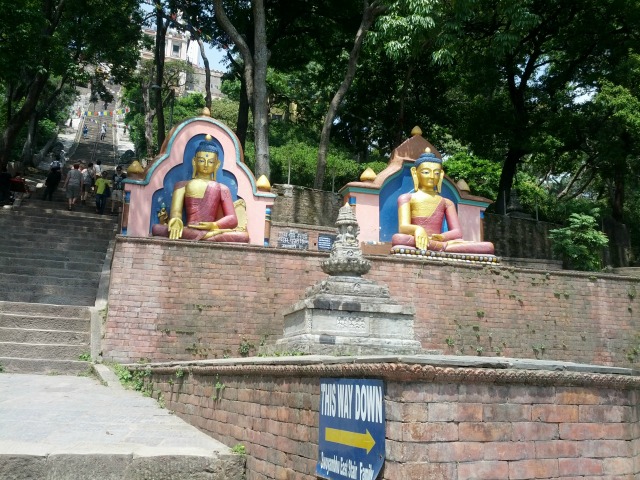
Two huge Lord Buddha statues guarded by two snow lions at the enterance.

This 12 feet prayer wheel is on the right side of entrance.
It takes at least two people to turn the wheel. Turning the wheel gives merits.

Climbing up, you see plenty of stones inscribed with the sacred mantra, Om Mani Padme Hum

a close up

Monkeys everywhere, one needs to be careful of these primates. They are quite harmless if left alone but do not try to provoke them.

The place is aptly named the Monkey temple!
The climb is interesting and many scenes can be seen on the sides.

Maya devi, the mother of Gautam Buddha.
These two images were actually on either side of the climb but I have put them together.
Lord Ganesha and his sibling Kartikeya. Again, these were separate which I have displayed as one.

Shila lekh on slate
woman concentrating on carving out a piece

Chaityas

souvenirs for sale
Beautiful things like the singing bowl, wooden masks, prayer flags, prayer beads are common things on sale.


still a long climb ahead :(
a close up
entrance ticket
front view of Vajra
A huge Vajra or thunderbolt placed by king Pratap Malla guarded by snow lions on its either side welcomes one on entering. A Tibetian calendar with zodiac signs is just below it. You can see dog, pig and mouse here.
a close up and side view
panoramic view giving the layout of Swayambhunatha
 |
| Anantpur and Pratappur towers |
Anantpur and Pratappur are two bullet shaped towers on either side of the stupa. These towers or shikhars were built by King Pratap Malla in the 17th century in memory of his wives, Ugratara and Vajrayogini. Unfortunately, Pratappur tower succumbed to the wrath of earthquake in April 2015.
Prayer bells and butter lamps surround all across with Buddha in niches at the base of stupa
Buddha statues in niches at the base of stupa
A lot of maintainence is needed to restore them fully.
A monk performing Kora. Kora is a Tibetan word and means circumambulation or going round a holy place. Hindus circumambulate around the temple deity and call it Pradikshana. While performing Kora which is always in clockwise direction, a devotee rotates the prayer wheels in a clockwise direction.
He may have also have prayer beads in hands thus meditating while going round. It is thus a method of meditation. Some people might be seen turning the hand held prayer wheel also.
Dhyaani Buddha, Vairochana and Akshobhaya.
Around the stupa can be seen statues of five Dhyani Buddha--- Vairochana, Amitabha, Amoghsiddhi, Ratnasambhava, and Aksobhaya and also their consorts.
Four dhyaani Buddha behind gilded copper work face in the four cardinal directions- Amoghsiddhi to the north, Ratnasambhava towards south, Akshobhaya to the east and Amitabha towards the west. Vairochana is supposed to be in the centre so he is placed slightly left of Akshobhaya.
Amoghsiddhi behind the mesh
Vairochana in white denoting space
Ratnasambhava in orangish yellow denoting earth
The other dhyaani Buddha Akshobhaya is clothed blue denoting water, and Amitabha in red, a symbol of fire.
In between the dhyaani Buddha are their consorts.
beautifully carved work over the dhyaani Buddha
You see the same features as in Boudhanatha, Boudhnatha Stupa, Nepal. Here, instead of square bhumis or steps, they are round. Harmika has the same features along with an umbrella on top.
The squiggly nose which is number one in Nepali script denotes one way to enlightenment. The compassionate eyes of Buddha who sees and blesses everyone. The third eye represented by a dot is the eye of enlightenment.
a close up of the compassionate all seeing eyes
There is still so much to write but I just realized, I have been going on and on. The post seems to be getting too long.
I shall continue in my next post where I shall write about monasteries and temples surrounding the stupa.


