
Having seen the Jaguar Temple which is one of the three main temples, we head towards the High Temple and Mask Temple.
High temple N10-43:
As the name says this is a 33 meter/ 108 feet temple and is the tallest structure in Lamanai till now.


The Mask Temple is 20 meter high and has two faces/mask which are 13 feet on its either side. They probably represent a Maya King.

It was built around 200 B.C. The structure seems to have undergone five alterations. The last modification was made around 800 A.D. The additions or modifications were mainly made to the front side and adding of platforms.


The masks as seen now are cut from blocks of limestone and mortared together. They were then covered by a thin stucco coating by adding wood ash to give a blue-grey color.


 We were served a hearty lunch of rice and beans, chicken stew, coleslaw, fried plantains, water melon and ofcourse not to miss the Belizian hot relish of onions and habanero peppers.


High temple N10-43:
As the name says this is a 33 meter/ 108 feet temple and is the tallest structure in Lamanai till now.
panoramic view of temple
front of the temple
this is how the temple must have looked when it was constructed
Construction of temple began in 100 B.C. over what looks like a residential place as fire pits and things related to households have been found at its base. But why was this place chosen to build a temple? We do not know.


High Temple in 600-700 A.D.
For almost 700 years very minor changes were made to the temple. Last addition to it is said to be made in 700 A.D.
Around 900 A.D., the temple was abandoned. But probably around 13th century, some offering seems to have been made as some shells, obsidian, a small piece of jade has been found.


only the center part partially remains

I looked up to the steep steps and for a moment panicked, how am I going to gather that much courage to climb to the top? Climbing these steps seemed to be a very daunting task. Earlier there was a rope in the center. Visitors climbed the temple holding onto the rope. To preserve them from being eroded, there is a stairway on the side of monument now.


stairs leading to top of temple

The stairs reach a landing and from there another series of steep though short stretch of steps lead you to the ceremonial platform. I was not brave enough to climb up. If you suffer from vertigo or have fear of heights like me then the climb might not be easy.
enjoying the view from top
view of New River lagoon
The temple was dedicated to Chaac, the rain god and also served as an observatory.
I always wondered why Maya built temples so high and if I am finding it so difficult to climb these steps, how did they do it? I got my answer while reading panels at the museum.
I am writing what is written in the panel at the museum.
"People often remark that the steps that lead to the top of Maya temples are incredibly high when one considers the fact that the Maya were relatively short people. In truth, their steps are high but one must understand that their temple were not made for anyone and everyone to climb. These places were sacred; they were only used for important rituals, and were only accessed by elite ruler, priests and their assistants. Their height also influenced they way these people climbed them. In other words rulers, priests, etc., would have to climb them with much dignity and reverence, possibly on hands and feet in a sign of respect to the deities they were about to worship."
Howling sounds could be heard from the trees nearby and you felt you were in midst of a Jurassic movie :) They are the howler monkeys
Mask temple N9-56:
Passing through cobbled path lined with cohune palm on both sides, we reach the Mask Temple.

Though the smallest of the three main temples, I found this west facing temple fascinating. It reminded me of temple run :)
The Mask Temple is 20 meter high and has two faces/mask which are 13 feet on its either side. They probably represent a Maya King.

this temple from 200 B.C.- 450A.D.
It was built around 200 B.C. The structure seems to have undergone five alterations. The last modification was made around 800 A.D. The additions or modifications were mainly made to the front side and adding of platforms.


mask on left side of temple mask on right side of temple
The masks as seen now are cut from blocks of limestone and mortared together. They were then covered by a thin stucco coating by adding wood ash to give a blue-grey color.
The left side mask shows signs of damage specially to its nose.
The mask on the left side of temple from where a stairway goes to top, is much better and clear. It has a crocodile head dress, strengthening the importance of crocodiles at that time and the name of site, Lamanai.
mask on right side

left side mask
Remains of a man and woman were found under the temple. They had jade jewelry and were buried with cloth, mats. It looked like a ceremonial burial. They could be rulers, brother or sister or husband and wife. In the absence of any evidence, it is impossibe to ascertain their relationship.
On way back, I see a palm with spines and was told "give and take palm", Chrysophila argentea.
The trunk of the palm has sharp downward pointing spines and careless handling can be very painful.

I wondered why this palm tree should be called "escoba", but found that the word in Spanish means to sweep up or in other words a broom.

the spines
But why should it be named 'give and take' ? The large palm fronds make excellent material for making brooms and while taking them off the palm tree you can get hurt badly by the thorns. The thorns form painful blister. The thorn needs to be carefully taken and a poultice made from the bark of the same palm tree acts as an antidote. Probably that is why it is named as give and take: you take the palm frond off the plant and also get thorns!
With this, we finished our tour of temples and are now tired and hungry, we head to the dining area.


lunch plate

everyone enjoying lunch

souvenir shop
Museum:
Museum is an interesting place with much information on temples and life of people in Lamanai.

artifacts

a typical Mayan house

Before concluding my post, I have to thank Ian who was ready to answer any question and supplied us with so much knowledge.
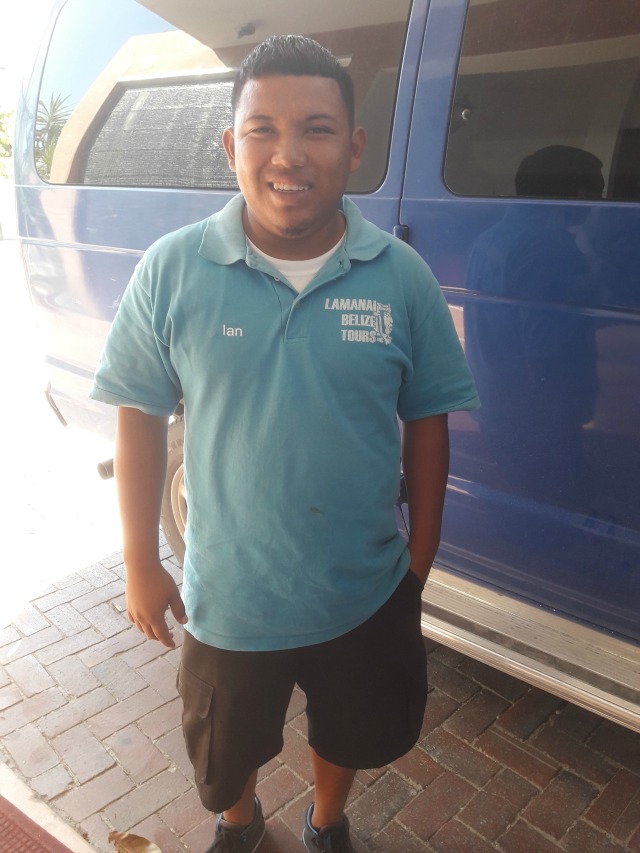
Ian
After one hour journey back to the hotel, we were dead tired and could just think of a good shower and a cup of coffee!


