Wednesday, January 7, 2026

Angkor Thom, Siem Reap

Derived from the word, Nagar (नगर) meaning city and Thom meaning big, Angkor Thom or Nakor Thom was the last capital of the Khmer Kingdom. It was established in the 12th century by King Jayavarman VII. It included many monuments, some built by Jayavarman VII and some by his successors.
The city covers an area of 10 square km.
South Gate


History of Angkor Thom:
  • Yasodharapura (यशोधरपुर)  was the capital of Khmer Kingdom which was established by Yasovarman I in the late 9th century.
  • After this, Hariharalaya was made the capital.
  • Jayavarman VII made Angkor Thom the capital after driving the Chams out.
  • Till the time his palace was under construction at Angkor Thom, the King lived in Preah Khan.
  • Angkor Thom was a huge city and already had few temples as Baphuon and the Phimeankas which were built in the late 10th and early 11th century.
  • With the fall of Khmer kingdom in 1432, it was abandoned.
  • Additions were made inside the city as construction of Bayon, elephant terrace, Leper King terrace.
  • The elephant terrace and the Leper King terrace formed the eastern boundary of city.
  • The city had thousands of people living in wooden houses, which are no more and we now see vast empty land. 
  • All the gates had huge wooden gates which used to close at night
The 9 km square city was fortified by eight meter high wall which is further surrounded by a 100 meter wide moat.
Entrance to the city was through five gates: North Gate ( Thvear Ta Nok), South Gate (Thvear Tonle Om), East Gate, also said to be gate of the dead (Thvear Khnoch), West Gate (Thvear Ta Keo). In addition, there is another gate, Victory Gate (Thvear Chey). The famous Prasat Bayon is a part of Angkor Thom and stands exactly in its center.
South Gate
Most of the tourists coming from Siem Reap pass through this gate to enter Angkor Thom.
The causeway of the moat is lined on either sides by stone figures. On one side are 54 Devas (Hindu deity) and on the other side are 54 Asuras( demons). They are seen pulling the body of snake Vasuki who is the King of Nagas. The scene depicts the mythological Hindu story of the "Churning of the Ocean Milk". This scene is also seen on the southern gallery wall of Angkor Wat
The story tells about the ocean being churned by Devas and Asuras so as to extract the elixir of being mortal. Vasuki, was used as a rope and Mount Mandara or Meru served as the pole around which the ocean was churned.
  moat surrounding Angkor Thom
Entrance to Jayavarman VII's capital is through a causeway and a naga bridge. Similar thing can be seen at the entrance at Preah Khan.
The outer wall of Angkor Thom is a square that measures 3km (1.8 miles) on each side. The total length it covers is 12km or 7.2 miles.
The gate with large heads, commonly called the "face towers" are very similar to the ones at Bayon. The heads which either represent Lokeshwar face, Brahma or King Jayavarman VII face in each four cardinal direction. Lokeshwar is the Boddhisattava of compassion. According to some historians, it may represent King Jayavarman VII himself.
The gates are 7 meters by 3 1/2 meters. They had wooden gate which used to be closed at night.
 wooden gate still can be seen

The gates are flanked by 3-headed elephant, Airawat, with God Indra sitting on his back. Indra has a vajra, lightning bolt in his hand. Since Indra was the king of gods, the whole structure symbolises to Mount Meru. Mount Meru is said to home of gods.  Above Indra, can be seen a row of devta with folded hands.
God Indra is seen with two divinities by his side. It is also believed that it may be a depiction of the King JayavarmanVII with his two queens.

Devta on the west side:
the devta, west side

The devtas have a comparatively slender face with oval eyes and a peaceful smile

Asuras on the east side:
Pulling Vasuki on the causeway, Asuras on east side
 renovated face of asur
 The Asuras have grimacing faces with bulging eyes. Their expression shows to win any how

North gate:
North gate is very similar to the South gate. The moat is not visible as there is a heavy growth of trees on both sides of road.

Like the South Gate, the sides of the gate has a three-headed elephant on top of which rides Indra.
Indra on Airawat, praying figures above Indra
Vasuki has been depicted with feet!
Fierce expression on Asura face

Angkor Thom contains many places worth visiting. To name just a few:
  • Bayon
  • Phimeanakas
  • Baphuon
  • Terrace of elephants
  • Terrace of Leper King
  • Tep Pranam
 The gates are fascinating and one of the most visited places.

Sunday, June 29, 2025

Hội An, Vietnam

An ancient city 45 minutes drive from Da Nang is  Hội An. The still protected town bustles with tourists specially on its walking street.

History of Hoi An:
Hội An was founded in the mid-16th century. It developed from a small fishing village to a trading port attracting traders from China, Japan, Europe and Korea. Over a period of time, the influx of merchants gave rise to unique ancient houses which reflected the amalgamation of different cultural features in its architecture.
Soon, the Thu Bon river dried making it impossible for large ships to enter. The city started losing its status of trade and was almost forgotten for many years. But, this proved to be a blessing as the city did not change with the changing times and maintained its old culture. It later became a UNESCO World Cultural Heritage in 1999.
Credit of preserving and giving it the status what it is today goes to none other than Kazimierz Kwiatkowski, a Polish architect. His perseverance and exchanges with authorities on keeping the old buildings remain in their original form is what we see today.
The old city is preserved and we see ancient houses and bustling vendors and shops as we pass through the streets.

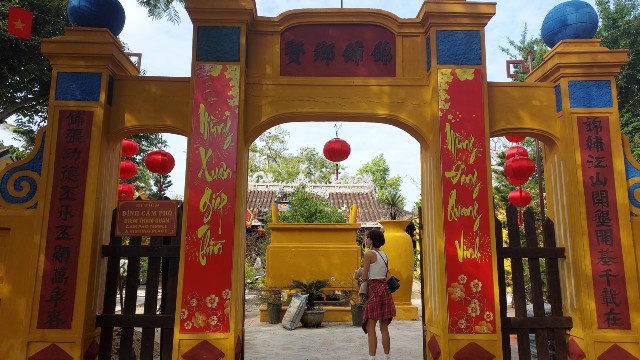
entrance to walking street 
Red Seal Ship
The Red Seal ship were Japanese commercial sailboats during the 17th century.

Walking street, where no vehicle is permitted.
The street is lined by lanterns on both sides. The street looks very pretty when they are lit up at night.
The street is commonly known as Thi Minh Khai Street.


lantern street
a Chinese temple by roadside


lantern frames are ready
 Hội An is said to be famous for lanterns.
There is also a choice to take the ones on display.
The frames and fabric are ready in all shops.  You can chose the fabric, color and pattern of your choice. The customer decides on the type and size of frame. Once the fabric is finalized, the shop owner cuts the fabric and sticks them to the frame. It takes almost quarter of an hour to complete the lantern.
There is also a choice to take the ones on display.
girl making a lantern
The fabric is cut and stuck on bamboo frame using glue.
Nguyen Thi Minh Khai street
shops by roadside
more lanterns for sale
Phung Hung ancient house
The house was built around 1780, when Hội An was an important trading place. The owner named it Phung Hung, meaning prosperity.
It used to be a small shop selling spices as pepper, cinnamon, salt and also silk, glassware, ceramics. In 1993, it became a national monument.
There is an entrance ticket of 120,000 VND to see the place from inside.
reception area
The architecture shows a blend of Vietnamese, Chinese and Japanese. The house has been constructed using 80 columns and the roof has interlocking tiles representing Yin and Yang
another old house
Japanese wooden bridge
walking down the same street is a bridge. The bridge was under renovation during our visit so could not see it properly.
The bridge was originally built in the late 16h century to connect the Japanese side to the Chinese part of town. The traders liked to use this bridge as it was a short distance and connected northside and southside of Hội An.
There is a small shrine in the middle of bridge.
Assembly Hall of the Cantonese Chinese Congregation
The Assembly Hall was constructed in the 18th century by Chinese traders coming from Guanzhou region. They were made with the purpose of gatherings and trading purpose.
It was initially made with the purpose to worship goddess Mazu( goddess of sea) and Confucius. Guan Yu, (Chinese military general) was added later to the hall.
It later became a center for assembly of traders for business purposes.

Kazik Park:
Walking down the street, a bust size image of Kazimierz Kwiatkowski is seen by the side of road.
Kazimierz was a Polish architect who was sent to Vietnam in 1981 when Vietnamese authorities asked to save their monuments which had been damaged during the war.
Monument of Kazimierz Kwiatkowski
Kazimierz, fondly known as Kazik worked for a very long time in Mỹ Sơn, protecting the remains of that place. It was only due to his efforts that Mỹ Sơn was recognized as World Cultural Heritage.

He negotiated with authorities to preserve Hội An and not to convert existing buildings to modern architecture as he saw the potential of tourism in this place. Some of the old buildings still exist here, which attracts a lot of people. It was solely his persistence that the ancient city of Hội An has become a thriving tourist place.
a man selling fish, birds from palm leaf
Thu Bon river
You see plenty of boats parked on the river to take tourists for a ride
View of ancient town of  Hội An with old yellow buildings,
old buildings in background

cute toy animals and magnets in a shop

taxis to take tourists around the city
We could have stayed a little late to see the lanterns light up but we had to return back to Da Nang. All in all it was a good experience.