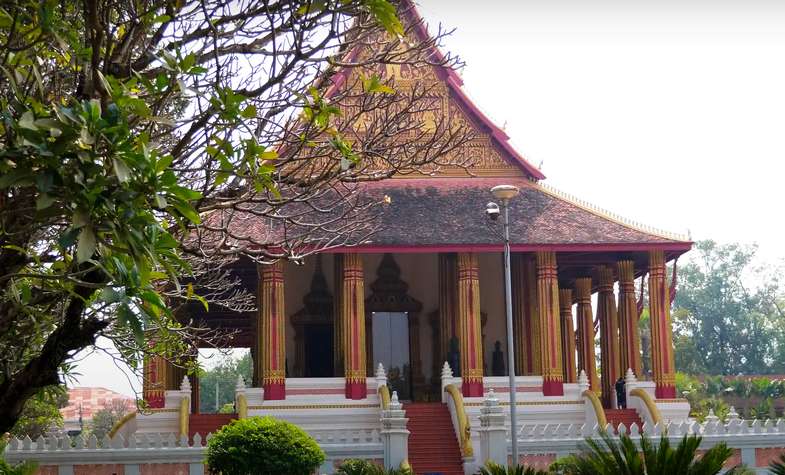
Wat Si Saket is the oldest temple in Vientiane and is the only temple which has still preserved its original form. Most of it has been turned into a museum.
History:
- Wat Si Saket was built in 1818 on order of King Anouvong or Sithathirat V (reign 1805-1828). He was the last monarch of the Kingdom of Vientiane. Soon after his accession to throne, Anouvong began a series of religious activities. He ordered repair of Ho Phra Keo, where the Emerald Buddha was kept and was taken away by the Thais later.
- he got the temple of Si Saket constructed as his own private monastery. The Lao lords and nobles came to pay allegiance to the King.
- In 1828, Vientiane was attacked by Siam, the temple was surprisingly left alone, probably because the sim had a Thai architecture.
- It is one of the few temples that escaped the destruction by Thai armies.
- The temple name Si is derived from the Sanskrit word Sri which is a title used to respect a man, god or even a book.
- In most places, temples run parallel to a river but this one was built at an angle. The purpose being that when the king prayed, his feet pointed towards the Mekong.
Some interesting feature of this temple:
- the temple is a mix of Thai and Laotian style.
- there are around 10,000 Buddha images here.
- Some images date to 16th century.
- houses the oldest Hang Hod
- a library which is kept closed
- multi-tiered sim
- it is the oldest surviving temple in Vientiane
Stupas form a row of funerary reliquaries along the wall of temple.
old stupa
Two old stupas stand beside each other near the entrance of Sim.
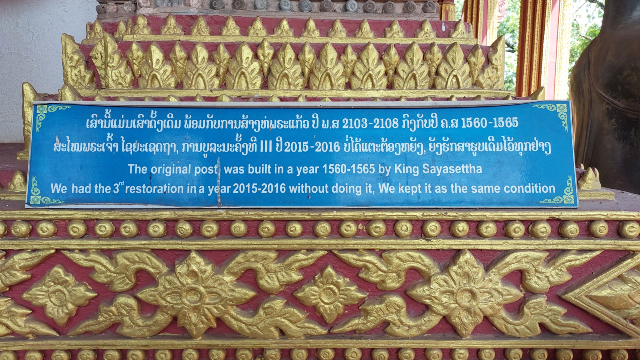
information board
entrance ticket
ticket counter

stone stele on either side of entrance
There are 8 animals which help us find animal according to our age. We need to count the number of years going clockwise. For women, start counting clockwise from buffalo and tiger for a man. Keep going round till you hit your age and the animal it corresponds to.
The animals on the slab starting from elephant going clockwise are: elephant, ox, garuda, cat, dog or dog yali (body of a lion and head of elephant), tiger, naga and rat.
Cloister surrounding the sim:
All around the ordination hall, is a cloister which houses thousands of Buddha images, the oldest ones being from the 16th century. The cloister and ordination hall have been turned into a museum.
cloister surrounding the sim
The courtyard corridor houses hundreds of Buddha images. There are said to be more than 10,000 images in the cloister.
Around 7,000 small images of Buddha are kept in niches mostly in pairs all around.
faded paint visible on top
Apart from small images, there are big images in different metals, stone, tin and wood.
a damaged image
a terracotta image with Muchalinda
This special structure above is very special feature of a Laotian temple. It is called Hang Hod.
This is a very old structure and not used now.
legs of Hang Hod stand
The Hang Hod now used is placed behind the sim.
side view
Naga head of Hang Hod
The Hang Hod is used only during the Laos new year celebrations.
swan shaped container for pouring water
Near the tail of Naga is an opening in which water is poured by devotees. The water flows through the trough and is used to bathe the images of Buddha and monks.
Devotees pour scented water in the container
Every year, during mid April, Buddha statues are all brought out and they are cleaned which forms an important ritual in the New Year ceremony. The scented water is then poured over them.
Sim in the center of courtyard
Sim or the Ordination Hall:
In the center, just in front of the entrance is a five-tiered Thai style roof hall.
The five tiered roof is decorated with chofaa all around the rim of roof.
The lowest roof on four corners has naga head chofaa. Upper two roof corners have Garuda tip chofaa.
On the top of the ordination hall roof is an ornament called
dok so faa. This is a very characteristic feature of a Laotian wat architecture. Dok so faa is placed right above the main image in of ordination hall. It represents the center of universe. In some places it is called Meru or Sumeru. Meru is a mythological mountain which is said to be the center of universe.
naga head chofaa on corners
gable of sim
Inside of hall:
Photography is not permitted inside the sim, I shall try my best to describe what I saw inside. I took notes so that I could remember everything.
In the center of hall, is a huge golden image of Buddha seated on a pedestal in bhumisparsha mudra, or "calling the Earth to witness". He is flanked by two standing Buddha images. Just in front are two more standing Buddha images. All the four images stand in 'do not fear', Abhay mudra
I had just visited Wat Ong Teu before coming here and was amazed that the decoration at the base of pedestal was very similar. This temple too has entwining naga with heads raised in opposite direction.
decoration at Wat Ong Teu
Since I could not take any picture inside, the above picture from Wat Ong Teu gives an idea. It is not exactly the same but very similar in style. The image is gold here whereas in Wat Ong Teu has a black huge image in center.
Since taking picture is prohibited, I am posting the above picture
Upper section of the room has niches in which are placed Buddha images. Each niche is beautifully decorated with flower patterns around. There are said to be more than 2,000 gold and silver images. Below these niches the room has murals, most of them faded by now. Some colors as red, blue, brown can still be seen.
Jataka murals depicting stories of the Buddha's past lives.
Murals inside the sim:
Since, photography is not permitted inside the sim, sample pictures have been put outside.
The Si Saket wall painting are not true frescoes in that they were
painted onto dry stucco rather than wet plaster. This makes them very
fragile and over time the drawings flake off.
The murals have
been partially restored. But, to preserve them, it is prohibited to take
pictures inside as the flashlights have a negative effect on the
colors.
I was overwhelmed when I enlarged the picture of window. I applied
exposure and contrast and saw this mural. I cannot see it clearly but
can
at least see some colors on the wall. I can also see two images of Buddha in one niche.
I did the same to this picture and could see faint mural at the back of the room.
King Anouvong chose to represent scenes from
Balasankhaya Jataka. The inside wall is painted at eye level which tell the stories about
the past lives of Buddha. Behind the altar is the story of Prince
Pookkharabat who appointed a thief as a minister and defeated many
armies.
The above picture shows deterioration of wall paintings over a period of
few years. The capillary salt deposits cause surface detachment and
spoil the pigments.

The wooden doors of sim are still in their original form.
intricately designed wooden temple door
door in the corridor
I had not noticed while taking the picture but when I was editing the pictures, I saw faint mural inside. One can imagine how pretty the murals must be inside.

wooden roof and windows in corridor
The windows too have not been spared. They are as pretty as the doors. One can see the Buddha images in niches inside the sim.
Garuda at the base of sim
Gable in front of sim by the side of corridor
Ho Trai or library:
The single roomed library was used to keep Tripitaka or the ancient Buddhist manuscripts.
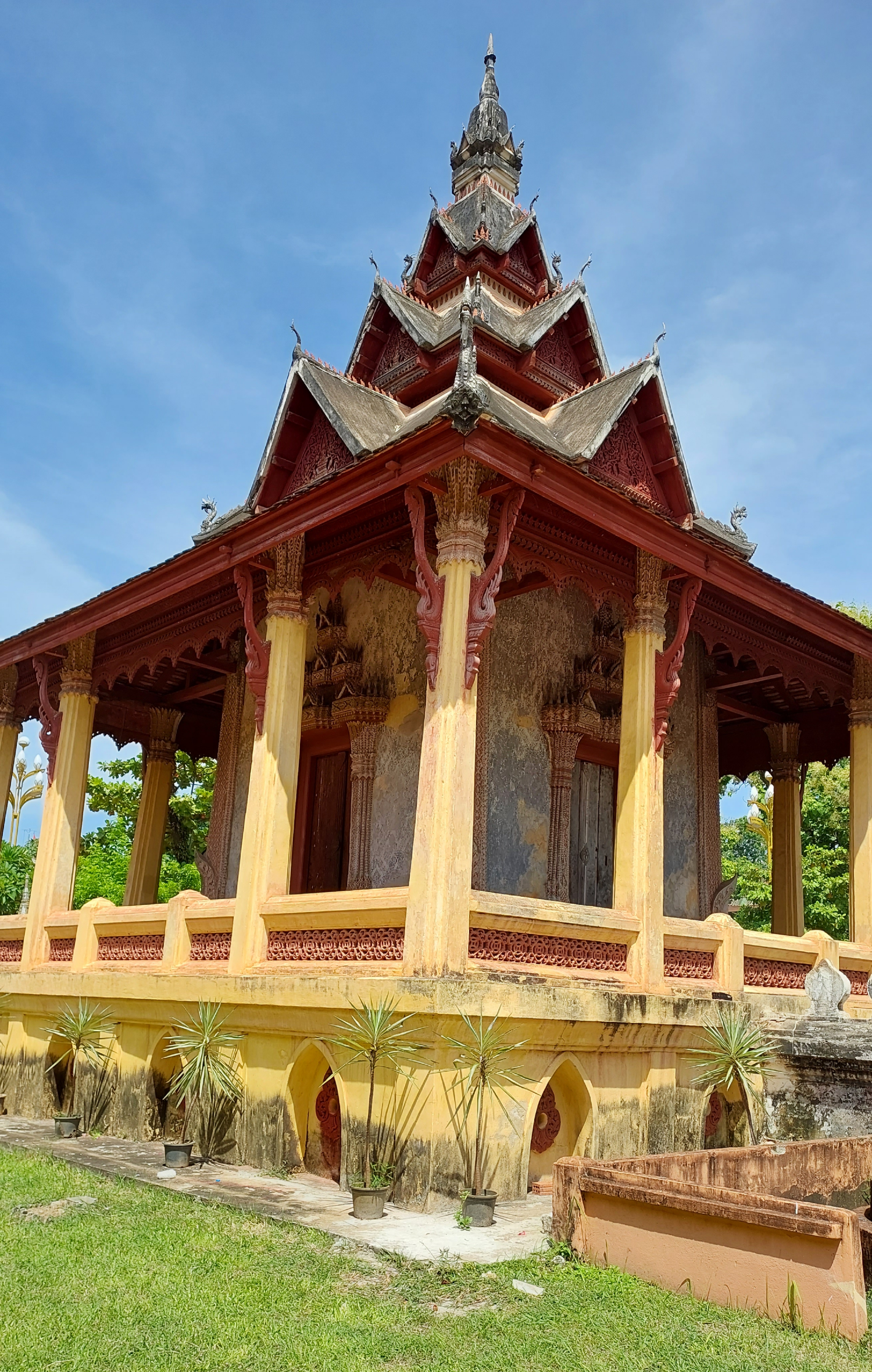
An old structure on a stone platform is the library or Ho Trai. It has a multi-tiered roof.
I noticed niches at the bottom of library in which there were holes. These probably are vents for air circulation to keep the air dry. This keeps the room above which houses the manuscripts dry and termite free.
beautifully crafted roof of Ho Trai
door post and work on top of door is exquisite
details of lintel relief carving
a photo shoot in progress :)
painted columns
More row of funerary reliquaries along the wall
probably old living quarters
The newly constructed building kuti or living quarters for monks.
gable of monastery
another side of monastery
decoration on the side
open pavilion with seated Buddha

the drum tower
This wat is definitely a place to visit. Spending some time in the ordination hall and corridor would be a good idea.
Opposite to Wat Saket is Ho Phra Kaew and I am off to see it.