Showing posts with label Amitabha Buddha. Show all posts

Sunday, February 8, 2026

Quan Su Pagoda, Hanoi

Very close to Hoa Lo prison is the Quan Su Pagoda. It is easily recognizable with its yellow and red tiled roof. Also known as the Truc Lam Quan Su, it is one of the oldest temples in Hanoi.

History:
During the Le Dynasty in the 15th century, Champa kingdom and Laos sent their ambassadors to pay respects to Dai Viet, that is the Le Dynasty. Emperor Le Thanh Tong got the place constructed where these ambassadors could stay. The temple at this time was known by its earlier name, Truc Lam Quan Su.
A temple was also built where they could all pray during their period of stay. This pagoda is the Quan Su pagoda with Buddha as the main deity.
At the end of Le Dynasty, when many pagoda were burnt down, this pagoda somehow managed to save itself.
In the 17th century, it was converted into a military warehouse, storing ammunition and weapons. The pagoda started to be called "Quan Su" meaning the "military mandarin".
It underwent lot of renovations and was finally opened to public in 1822. It became important due to its miraculous powers of being unhurt.
In 1934, the Vietnamese Buddhist Association of Northern region was established and Quan Su Pagoda was made the headquarters.
In 1942, the pagoda had a major renovation for its designs.
 
Architecture of temple:
main gate to temple
The main entrance to temple is through a wooden triple-arched gate which is not open to visitors. In the middle is the bell floor where hangs a big bronze bell.
There is a small entrance on the side. The red roof is slanting with a red tiles. The corners arch upwards.
The architecture is a blend of Vietnamese and Chinese.
entrance to temple
With bonsai trees on sides, 11 steps lead to inside of temple
 
 sides of stairs leading to main prayer hall
praying in front of pagoda
Roof of pagoda is decorated with a moon surrounded by flaming .....

main altar
The inside of temple is painted in red and gold symbolizing prosperity, happiness and good fortune. There are large gold plated images in the altar.
There are three tiers of the placement of images in the main altar.
  • Topmost tier: has images of three times Buddha, of the past, present and future represented by Dipankar (Buddha of the past), Shakyamuni (of present) and Maitreya (Buddha of future)
  • The bronze image is said to date back to 17th century.
  • Below this tier, is a huge image of Amitabha Buddha flanked by Avalokiteshwar Boddhisatva (Guanyin) and Mahasthamaprapta Boddhisattva. Mahasthamaprapta is one of the oldest boddhisattavas
  • Below the central tier sits Shakyamuni Buddha flanked by Ananda and Mahakasyapa.Bell on the right of temple
On the right side of main hall, the altar has a golden image of Monk Ly Quoc Su.
He is also known as Zen Master Nguyen Minh Khong. His name was Nguyen Chi Thanh and lived in the Ly Dynasty(10th-12th century)
The right side of hall is to worship Guan Yin
offerings
In front of Guan Yin is a drum
votive paper burning furnace

inside view of main gate
bell on top of main gate
information of temple
Library, monk's quarter next to main prayer hall
The courtyard around the main hall is library, monk's quarters, a reception hall, book stall, souvenir shop
The library here is said to have largest and invaluable collection of Buddhist scriptures and documents which are used in Buddhist ceremonies and rituals.

souvenir shop
hall for holding conventions
books for sale


Annual Lantern festival:
Annual lantern festival is celebrated every year on 15th day of the Lunar New Year. The temple is decorated with plenty of lanterns.

Timings:
The pagoda opens daily from 7:30 to 11:30 AM and from 1:30 to 5:30 PM

Saturday, March 15, 2025

Tam Thai pagoda, Ton Tam Pagoda, Tu Tam Pagoda, Da Nang

Turning left from the relaxation area is Tam Thai pagoda. Not a very big pagoda but it is one of the oldest.
There are 3 pagodas side by side. 
History:
  • The written account of this pagoda state that it was  built in 1630 under Le dynasty and Hung Lien, a Chinese monk became the abott
  • Tay Son period (1717-1802) was a devastating period and the pagoda was completely damaged.
  • It was rebuilt under King Minh Mang dynasty and was renamed Quoc Tu in 1825.
  • It was again rebuilt during Nguyen dynasty and was declared a national pagoda.
Architecture:
  • The art work is something which one needs to spend some time on. Like Linh Ung Pagoda, small multicolored porcelain tiles have been used to decorate pagoda.
  • The entrance gate( a climb from gate 1) to pagoda is through a 3-door gate, the middle gate is only for monks, left one is for men and the right one for women. We went to the compound through the side of pagoda.  sign board pointing to pagodaTam Tai Pagoda
Entrance gate:
The entrance to pagoda is through a 3-door gate. 
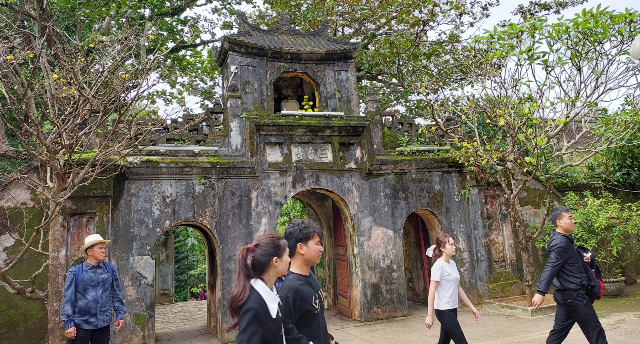
 Tam Quan gate(view from outside)
The middle gate is only for the monks, left one is for men and right for women.

 Tam Quan gate(view from the pagoda side)

The place where usually a bell is placed is a stele in white stone.
 
 
The wall behind the stele is painted. The colors have faded over a period of time with mold growing in places.
 
Phật Di Lặc is seen in front of the stele. I could not find out the details of of writings.
 A sandstone image of Phật Di Lặc, Laughing Buddha is kept in the courtyard

The roof is beautifully decorated with flaming moon in the center flanked by dragons. This is considered a distinctive architectural feature of the Nguyen period.
Below the roof are scenes from the life of Buddha.
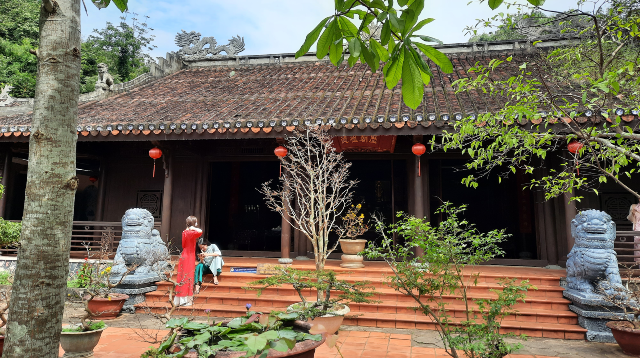
Either side of entrance to main hall is guarded by stone lions.

carved lions at entrance
 The ends of curved roof are decorated with dragons and a turtle.
In the main hall, there are three Buddha statues, Shakhyamuni Buddha in the center, Guanyin and 
Amitabha Buddha
Sakyamuni Buddha
a monk praying at the altar

special Vietnamese bells on one side and a huge bell on the side of pagoda
drum with bells
decorated columns of pagoda
Behind the carved lions are decorated wall on either side

guardians on both sides of entrance
Standing just outside the gate, is a heritage tree said to be more than 200 years.
the heritage tree standing tall
Very close to the tree, a flight of steps takes to another tower pagoda.
dragon with a pearl in mouth by the side of steps
a tower and Guanyin on the side


Tam Tai Pagoda below
Dhammapada sutra stone by side of steps
 
Ton Tam Pagoda:
Close to Tam Thai is Ton Tam pagoda.  There are three buildings-- one is the living quarters for monks and 2 buildings are temples.
 
 
 private property of pagoda
 The first building with lions outside is a part of residential quarter.


place for having food
wooden statues by the side of wall
living quarters
roof of living quarters

8-armed Guanyin


 Phật Di Lặc, Laughing Buddha outside the main hall

 Buddha image in the center

 Kshitigarbha Buddha

 Guanyin
 
on the side of  main altar
bell inside the temple
Temple of Guanyin:
Opposite Ton Tam pagoda, an image of Guanyin stands under a pavilion.

bell tower nearby
bell


can you spot a caterpillar?😃
Tu Tam Pagoda:
Going down the steps is the Tu Tam Pagoda.
way to Tu Tam pagoda
we side tracked and sat beside the image of Guanyin for some time looking at the view below.


below is a garden which is maintained by the monks. We got lost and missed the way to pagoda.
View of pagoda from the road which we saw later. The Vong Giang Dai, viewing point is on the right side.

Vong Giang Dai:
Behind the Guanyin, a way goes up to the viewing point. It is located on the south-west slope of Thuy Son mountain. The platform is 7 meter wide.
Co Co river can be seen at a distance below
In the center, is Tra Kieu stone slab which is about 2 meter high. It is engraved with 3 big Chinese characters: Vong Giang Dai. Beneath it is Minh Mang 18th year 7th lunar month, 1837.
View of mountains of Kim Son (higher one) and Hoa Son (lower one)
greenery in the mountains
view of part of Tu Tam pagoda below
where to next?
We return to relaxation area, then to Hoa Nghiem and Huyen Khong Cave.