Showing posts with label drum tower. Show all posts

Friday, March 22, 2024

Wat Inpeng, Vientiane

While passing through Setthathirath road, no one can miss the multicolored Wat Inpeng. With an image of Lord Indra at the center of entrance gate, Wat Xieng Nyeun in Laotian is very different from what I have seen earlier.
 
 entrance gate
History:
  • The temple dates back to 1700s.
  • It is said that during the construction of this temple, Pha Nya In(Indra) took the form of an old man and assisted in making the Buddha image. This legend gave wat the name, Wat Inpeng.
  • Although the wat was built in the 16th century, it was destroyed in 1827 when Siam invaded Laos.
  • the wat is active with monks residing in the compound, a library, many Buddhist structures and a beautiful sim or ordination hall.
 
 main entrance
The entrance is through a large elaborate gate. Seven-headed naga flank the gate guarding the temple.
 
 naga close up

Indra on top of the gate
Since, Pha Nya In or Indra helped in the construction of the huge Buddha inside the sim, an image of his sits on the top of entrance gate.
He sits with one leg on a red pedestal and the other hanging down. In his left hand, he holds a trident or trishul. The three iron spikes are identified with the three prongs of Indra's thunderbolt or vajra. He is sometimes seen holding the thunderbolt as well.
He has a crown on his head and sports a lot of jewelry.
rear view of the gate
The tails of seven-headed naga at either side of gate reach to the back of Indra.

 another entrance gate
Here, the gate is flanked by standing lions on a pedestal.

sim
 In green and gold, the wat's sim is very attractive.
 
The floral motifs gable is decorated with wood carvings with a Dhamma wheel in the center. Above the gable, an image of Buddha sits on a lotus.
 
the three-tiered roof of sim has a dok so faa at the center
Dok so faa is an ornamental arrangement which consists of 9 miniature pagodas, topped with 9-tiered parasols. It is said to be made from bronze and gold.
Two lions stand at entrance guarding the sim.

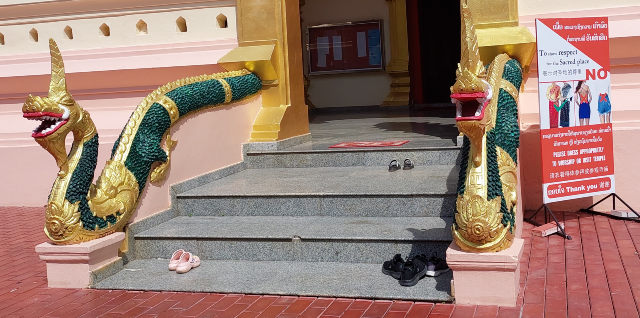
The side entrance have naga beside the stairs.
naga at side entrance
Naga with mythical fish
 
The sides of the porch too are richly decorated depicting scenes from Buddha's life. One scene depicts Gautam Buddha taking his seven strides as soon as he was born, symbolizing that this would be his last birth.
main entrance to sim
The murals on the roof of porch and the entrance doors are exquisite.
the wood carvings on side entrance is as beautiful as the central door
more murals on the side wall of porch
more on the other side
the roof has not been spared
more on the other side
richly decorated door
window in sim
inside of sim, the sim pillar are decorated in gold and red and give a very royal look
we were very fortunate as there was going to be a prayer ceremony and we sat in a corner observing.
The bricks and lacquer image of Buddha

prayer ceremony
Initially, we were hesitant in taking pictures of the ceremony, but I saw some clicking pictures. I took some pictures. The atmosphere was very peaceful and soothing.
The Buddhist chants which are in Pali, are chanted in chorus by the monks. People sit with their feet pointed backwards and listen to the chanting.
 
 I saw one woman read along with a bowl of offerings by her side.

hang hod, which is used to bathe Buddha on special occassions
another gate
A golden stupa stands just near the entrance.

Other places of interest on the ground:
Apart from sim, there are many things which interest a tourist.
As soon as you enter, small stupas line the boundary of wat.


a small temple with Buddha in bhumisparsh mudra
a golden stupa at the entrance of one gate
rock depicting Mon and Khmer period
Ho Trai:
On the north side of sim, is a square stone building or a room which is decorated with stone sculpting all around. Guards stand outside the entrance of the library. Ho Trai is used to keep the Tripitaka, which are manuscripts written on dried palm leaf and contain the teachings of Buddha.
Ho Trai or library
The stucco all around gives an entirely different feel to the place.
guards standing outside Ho Trai
undamaged pieces which survived the attack
a shrine
Lord Indra
King Settathirath
Phra Mae Thorani
By the side of a pond, which was dry when we visited is a statue of Mae Thorani or the mother earth, wringing her hair. The water drowned the armies of Mara, who tried to stop Buddha from meditating and he touched the earth asking the mother earth to come to his rescue.
golden slender stupa near the pond
drum tower next to golden stupa
kuti or resident monks living quarters
Canopies were there with tables and chairs, food was going to be served after the ceremony inside the sim got over.
another entrance


Opening hours:
The temple opens daily from 8:00 AM to 6:00 PM
Entrance fee: Entrance to temple is free

Sunday, March 17, 2024

Wat Ong Teu, Vientiane

Very close to Wat Inpeng is a wat with huge white elephants at its entrance.
The Wat Ong Teu is a Buddhist temple and was constructed soon after Vientiane became the capital city of Laos in 1354. Wat Ong Teu or 'Heavy Buddha' is name given to temple due to a large image of Buddha in the temple. This wat is one of the many important monasteries in Vientiane.

History of Wat:
  • The main temple building was constructed sometime between 1563 and 1572 (the king was murdered in 1572) during the reign of King Setthathirat I after the capital of Laos was shifted to Vientiane from Luang Prabang
  • The King wanted to have the image of Phra Ong Teu in a place where he could also live. The complex would have a sim(ordination hall), ho rakhang(bell tower), ho kong(drum tower), kuti or monk living quarters.
  • The purpose of this wat was primarily to pay respect to the king during ceremonies.
  • Souligna Vongsa(1637–1694) was greatly respected by his people. He, in contrast to Thai kings led a very simple life, wore no crown and always sat on a mat. He spent a lot of wealth on religion.
  • he made the temple into a Buddhist learning center. It soon became a school for monks in Southeast Asia to study dhamma.Till today, Laos is the main center of Buddhism.
  • Siamese army attacked Vientiane in 1827 and that took toll of the temple building. The original building was badly damaged.
  • From 1900, the temple started rebuilding and again became a center of Thervada Buddhism in Laos since the 17th century.
  •  the wat is an active temple, Lao Buddhist Institute was set up in 1929 and Hawng Sankhalat (Supreme Patriarch) of the Laos Buddhist resides here.
Things to see:
  • beautiful drum and bell tower
  • decorated pediment at entrance to sim
  • ornate pedestal below the images of Buddha
The entry gate in white is very simple in its decor. Two elephants standing on both side is devoid of flashy colors or any image.
dress code for visiting the wat
 
huge elephant at entrance


dok so faa on roof
Dok so faa are temple roof decorations particularly seen in Laos. They represent Mount Meru also called Sumeru. Mount Meru is a sacred mountain considered to the center of universe in Jain, Buddhism and Hindu. It is also said to be the abode of Lord Brahma.
There is a drum tower on entrance. Many Buddhist symbols as the Dhamma chakra, 7-headed naga, Sarnath pillar are all seen here.
drum and bell tower
Ordination hall:
The sim or ordination hall is richly decorated.
Both the ordination hall and bell tower have the same style of decorations on them.
Six small Buddha sit in a meditative posture above the double archway pediment. Flame-like decorations called chofaa, line the edge of the roof. chofaa is also used as decorations in Thailand wats.
The combination of gold on green with red gives a royal look to the wat.

two-tiered sim with dok so faa on top
the five-tiered post on either side of entrance are a very unique feature at Laos wats
entrance to sim
green and gold single headed naga at entrance, fish by the side of Naga is also a special feature of Laos wats
Unlike Wat Inpeng, the entrance to sim is not decorated but is very simple.
Made of mix of metals, mainly bronze, Phra Ong Teu graces the center
The floors have red carpet, the ceiling is simple with traces of gold. The pillars supporting the roof, however, have intricate patterns in red and gold. They have a lotus at the top which touch the ceiling.
the image is said to be the largest in Vientiane
Three Phra Ong Teu Buddhas are seen on a pedestal. The center seated larger image shows two mudras or hand gestures. His left hand is placed with his palm facing upwards which is dhyaan mudra or meditative posture. His right hand points towards the earth, Bhumisparsh mudra.
The ones standing one on sides have the 'do not fear' or abhay mudra.
The curly hair and the top knot with long ears is reflection of the Gandhara style during the Gupta period in India.
 three Phra Ong Teu Buddhas

details of golden pedestal
Something worth noting is the ornately carved pedestal. The pedestal have entwined gold naga with head raised in opposite direction.  
couple taking blessings
preparing for a prayer ceremony
A prayer ceremony was going to take soon after so we made a hasty departure.
gilded doorway
side carved gilded door with sai sin on top
White cotton bracelets(Sai Sin) are tied around wrists which have been blessed by Buddhist monks. These are supposed to provide protection and good health to those wearing it. In wats, the grid-lines are supposed to provide protection and good health to those who visit the place.

image on window grill
gilded grill and red and cold painted pillars
a figure on pillar
every window has a gilded work on them

gong at entrance
sai sin at side entrance
viharn on the side was being renovated so we could not go inside
preparation for ceremony opposite sim
Inside the room, preparations for after prayer ceremony were going to take place.
an image of Buddha pointing towards sim

laughing Buddha
 
The wat which does not attract many tourists. I would not say that the temple is very beautiful but the interior of sim is exquisite.
 
 
Timings: 8:00 am to 5:00 pm
entrance fee: free