Tuesday, January 14, 2014

Kopi Luwak, Indonesia

Coffee lovers would agree that this is one of the world's most expensive coffee.  A cup of coffee costs $25!
That much for a cup of coffee? But why is this coffee so expensive and what's so special about it? 
I could not avoid not noticing kopi luwak signs everywhere in Bali.

Kopi is the Indonesian name for coffee and lewak is the Asian palm civet.

History of coffee in Indonesia:
Indonesia was a Dutch colony in the 18th century, and they started the plantation of coffee Arabica. 
The natives were prohibited from consuming this coffee but they were naturally tempted to taste it. They soon discovered  that the Asian Palm Civet or luwak ate these coffee beans. Once inside the stomach, the beans underwent a change.
The civet's digestive system could not digest the coffee beans and still- intact and undigested beans were passed out. However its digestive juices gave coffee beans a different flavor. The natives noticed the undigested beans, collected them, dried, roasted, and ground  them. The flavor was too good.  The fame of this flavor soon spread and it became a priced and expensive beverage since the process took a long time. You obviously had to rely on the civet !

We went to such a place near Ubud where they have a kopi luwak plantation.  My children desperately wanted to see the civet but were not too interested in drinking coffee at that time.  One person took us around the plantation where he showed us trees and plants of ylang ylang, coffee arabica, mango, cocoa, cinnamon, vanilla, turmeric, galangal, and ginger.  We came to a row of cages where these civet were kept.
civets in captivity in a coffee farm
It does make you sad at seeing these civets in captivity. Pity these animals who are forced to eat only coffee berries and this is a cause for concern. Moreover, what is the fun of having such an expensive coffee at their cost, even though it may taste heavenly.
The civets are fed these beans.  The undigested coffee beans are collected, washed properly in hot water. They are then dried, roasted and pounded to get the coffee powder.
      undigested coffee beans           washed and cleaned  coffee beans       manually roasting the beans                                                                                                                      
                pounding the coffee                            sifting                                         final outcome                                               

coffee on the table

I am not much of a coffee person, and honestly did not find any great difference and wondered about the high cost.  But my daughter who drinks a lot of coffee said that the coffee is mellow and does not have an after taste.  It has a rich flavor too. That said, it was not worth the price of putting the animals to such torture.
We were also offered a selection of 15 different teas and coffee to taste.  They was free sampling except for Luwak coffee.  I liked a few of them.

a selection of teas and coffee to taste
Among the teas, I liked lemon and rosella or sorrel and found coconut coffee an interesting flavor.

Though, not heart warming, the experience of visiting this place was different.

Time to paint

I am always on look out for something to paint on.  In fact, my friend K the other day joked about it and said, we are just waiting to see your husband painted !!!
I saw these wooden cutting boards in supermarket one day.  Why not paint on the reverse side?  I had something like this in Russia but the their painting is far more superior to mine which they superbly do. 
I got two pieces home and painted on the wrong side, sealed the paint with acrylic sealer and now one hangs on my kitchen.


unpainted cutting board

The above pattern, I learnt from di Marzia Di Somma's video on you tube, she is too good.
My sister visited us some time back and got a box of these LED candles.  Why not paint on them? she said so I sat with brushes and paints.  The outcome was far more than I had expected. They looked specially beautiful when they were switched on.
The above picture didn't come out well.  I used my mobile phone camera :(

My painting endeavors continue and you would be seeing more of them.

Monday, January 6, 2014

Recycling dvds and cds

I had written a post on recycling in which I had put some pictures of recycling dvds. I recieved request for a detailed description of them.  Actually, I had collected a stack of dvds over a period of time.  Any new movie released and the dvd would be with me.  But how many movies do you keep? Most of them were not worth viewing the second time so off they go in trash.  But, why do I throw them away? Can't I do anything with them? Make use?

I am a person who loves to recycle stuff and feel sad at throwing things away.  Recycling also gives me a sense of achievement.

Making crochet hot pads with dvds inside was a huge success for me and I made plenty of these.
But how many do I make? What to do with the rest?  There was nothing as painting over on dvds and using them. So, I experimented with one. No loss, I was throwing them away anyhow. The color refused to stay at one place and would come together.  I figured out, and yes, you need a thick coat of paint over it.

Instructions for painted dvd and cd coasters:
Clean a dvd properly, make sure there is no grease on it.  The paint will not stick properly if the surface is oily.
There are two sides of a dvd or cd. One might have the contents of the disc written on it and the other shiny side.
                            shiny side                                                non-shiny side                                 
It does not really make any difference which side you paint on but some times the written stuff is visible through the paint so,  I prefer to paint on the shiny side. 
Apply a thick coat of acrylic paint. 
Let the base coat dry.
Let your imagination run and paint whatever you want to paint.  Experiment with it. You were going to throw it anyway :)
The above set of cds painted with alpana patterns
Experimenting painting flowers
Now, the paint may wears off and gets scratched easily after some time so an acrylic sealer needs to applied.
Spray the painted side liberally with acrylic sealer. 
Take precaution to do this in the open, inhaling the vapors is injurious.
Apply one or two coats more. 
Let your creation dry.
The following step is optional, I personally like to hide the back side.  So, I apply a thick coat of UHU glue and put a backing of matching or contrasting felt.
Trim off the edges to give a neat outline. 
And, your creative coaster is ready. 

Notes:
You can use this coaster for hot tea or coffee mugs, for wine glass or as a base for a vase.
If, the backing is not applied, it on can be stuck on the wall to brighten a kitchen or bathroom.
Never  put a hot pot or a candle votive over it. The sealer melts. 
You can easily wash them with soap and water.  Do not put it in a dishwasher.

Crocheted dvd and cd coasters:
I crocheted few of these dvds with left over wool.  Well, they are not my creations. Most of the patterns are taken  from http://www.crochetpatterncentral.com/. I did bring in some changes.
The advantage I found in these crocheted ones over the painted ones is that they make excellent hot pads on a kitchen counter or on dining table.  The wool casings can with stand heat from the pot and they look pretty on the table.

So, its time to impress your family and friends and get plenty of compliments.
Imagination and creativity have no boundaries so pick up your brush and colors and get started.

Sunday, January 5, 2014

A peep into Bali

Bali  is a place that vibrates with rituals and culture.  It is intoxicating and embraces people of all ages in its folds. From sea beaches to temples, from volcano to paddy fields, Bali has it all.  Added to all this is its rich culture which attracts people from all over. 

Greetings:
Balinese welcome people with  folded hands and say Aum Swasti Astu (aum) (ओम )= a mystical mantra, the primordal sound; swasti(स्वस्ति ) = all peace, astu (अस्तु )= be it so, so putting it in simple terms, peace be upon you. 

Lord Ganesh:
I don't need to give much introduction to the picture below.  He is lord Ganesh, the most revered of all gods. He is supposed to be a hurdle remover, wisest of all, and no Hindu  ceremony ever commences without His blessings. The entrance to a Bali house is graced by a statue of Lord Ganesh. He is revered in South-Asian countries as well. 
                     A Chanang is always placed in front of Lord Ganesh who is the all Supreme

Yaksha and Yakshika(यक्ष -यक्षिका) :
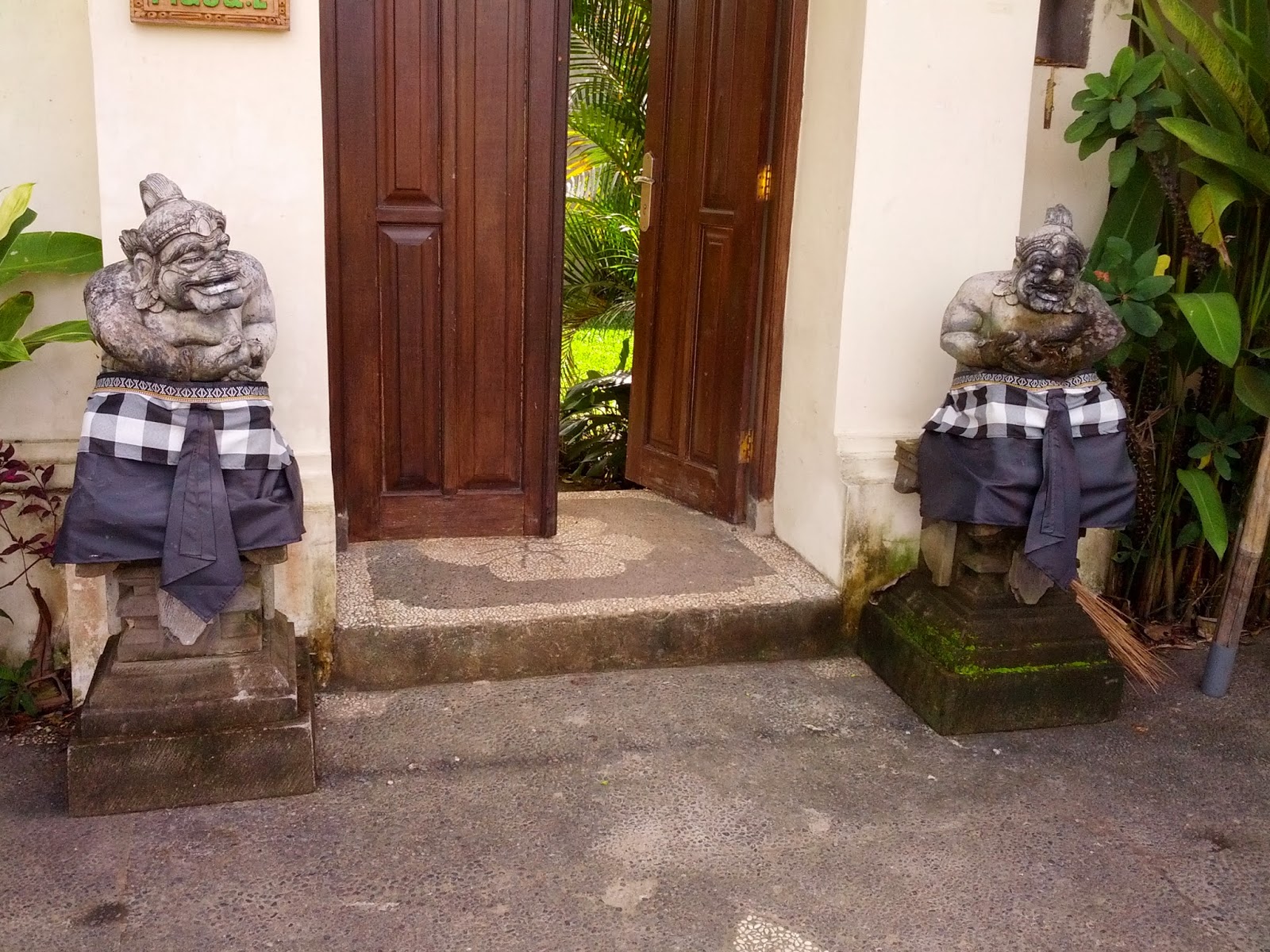
Apart from Ganesh, you cannot miss the stone statues on either side of the entrance.

But what are they and what for? I was talking to some one and she referred to them as demons.  Hold on, they are not  demons.  But are callled Yaksha and Yakshika.
They are supposed to be protectors of Kuber, the god of wealth. Since, a house is the place of wealth, these figures protect your house.  Some statues are beautifully decorated  and painted. Sadly, I could not take pictures of them. They are covered with white and black check cloth.  White and black symbolizes the good and evil.  There needs to be a balance of this in a house.

I was tempted to get a pair of Yaksha and Yakshika  back home with me, but they are made of stone and were so heavy.  Maybe, in my next visit, I will succeed in finding a small pair.
                               Yaksha                                                                                Yakshika                                    
Penjor :
Penjor at Besakih temple                                                      Penjor at GWK
The long bamboo pole that you see in the above picture is called a Penjor.  These are placed  along road sides or inside a temple. This long bamboo pole is very artistically decorated with dried coconut leaves.  The upper end tapers down. There are many versions of the significance of a Penjor. I don't know which is the correct one but whatever it is, they look very pretty and  give Bali an exotic and grand look.

According to mythology, Mount Meru is considered to be the center of universe by Hindus.  This mountain rests on the hood of Vasuki, a coiled gigantic coiled serpent.  Penjor symbolises Vasuki with its mouth towards the earth.  The long bamboo pole with its tapering end resembles a serpent. You would see offerings near the mouth or base of this pole to keep the serpent satisfied.  Mount Agung, which is the highest mountain in Bali is said to be synonymous to  Mount Meru.  Young coconut leaves on penjor are the scales of the serpent.

Another version as was told to me is that a decorated Penjor symbolizes mountains and the forest which should be protected and thank the nature for all it has given them.
I was told that they are decorated beautifully during Galungan which unfortunately, I have not had the chance to see.  On my trip, this time, I saw most of them covered with a cloth.
   Penjor covered with cloth                                       Penjor decorated  with coconut leaves
Gebogan:
Gebogans are Hindu Balinese offerings to God.  They are pyramidal in form and are made of fruits, flowers, chicken, coconut, rice. Women folks carry the gebogan on their heads to the temple. There they are offered and blessed by priest.  The perishable items are consumed soon after.  Some are taken home to be shared with friends and relatives. The gebogans are traditionally meant as offerings for God but now they can seen as decorative purposes also.
A temple procession with women carrying Gebogan on their heads
A decorative Gebogan 
I was breathtaken by the beautiful gebogan pictured above which Conrad, Bali had placed near their melt-in -the-mouth granola squares and muffins.

Bali kites or Layangan :
Do I add kites to this post? Is'nt kite flying a fun activity ?  But, in Bali, kites or Layangan as they are called there are supposed to take the message to Hindu gods of giving them a good harvest ! 
Bali has an international kite flying competition in July every year. You see a variety of kites as dragons, owls, parrots, frog...the list is endless.
So, along with fun, kite flying is also a ritual.
I liked most of them and had a difficult time deciding what to take home. Afterall, they had to be carried with so much care during the journey.
A sail boat shaped kite at Tanah Lot
Dragon shaped kite adorning my wall   

Plenty of kites fly in the skies of Tanah Lot.

CChanang- Balinese offering, Bali

Bali's beauty and serenity is something which intoxicates you the moment you land on this breathtaking place. 
No one can miss the ubiquitous offerings on entering Bali.  They are seen everywhere - on airport counters, shop counters, outside and inside homes, near a swimming pool, on temples, on a car dashboard.
The day begins at every Balinese house with offerings called Chanang. They are put at the entrance of the house and at most places where you would want the safety of people, for instance, inside the house, temple, near a swimming pool, or a gazebo.
Outside a house 
But, what are Chanangs and what is their purpose? Chanangs are an offering to gods to seek their blessings and also ward off or satisfy the bad spirits called the buta kaala from entering the house.
They are usually made from pandanus leaves with banana leaf in the center, and offerings placed inside. Usually, the leaves are attached using a stick but now, it is so much easier to staple them together. The offerings are then put inside the Chanang which usually consists of few flowers, a dhupa (incense stick) and other things varying from chocolates, to biscuits to candies.  A simple chanang can be a small amount of rice and placed outside the house.
 I wanted to see what is done, so took some pictures of the girl who came to put the chanangs at our place of stay.  She sprinkled some water with a flower over the area thrice and prayed for the well being of the house.  She then put the chanang at different places around the house.
   Chanangs for the house                     Sprinkling the area  with water              Chanang at doorstep                                                                                                             
Another thing which I noticed in Bali is the dress code on visiting a temple or performing any ritual. The Balinese have very strong religious beliefs and one needs to be properly dressed when visiting a temple.  You have to wear a blouse, a sarong and a sash around your waist.  You can see the attire of the pretty girl in the above picture.
On a airport counter 
I was talking to some old folks there and was praising the traditions which the Balinese are still continuing and we agreed that with the change in new generation, we hope the culture and rituals continue through the coming generations.
Bali Chanang

Thursday, December 12, 2013

Lavang latika

This Bengali sweet makes me drooling at its name.  A visit to Hauz Khas or Chandni Chowk in Delhi is never complete without a visit to Annapoorna.
It gets its name from lavang which means clove and is inserted to seal the folds. This also imparts the flavor of clove on frying.  I could not however, get the Annapoorna flavor but analysed the sweet closely this time eating it slowly and trying to get hold of all its flavors.
I used to put saffron, almonds to the khoya mixture earlier but I noticed that adding nutmeg gives it a wonderful flavor.


Ingredients:
For the outer shell:
2 cups maida/ all purpose flour
4 tbsp melted ghee
1/2 tsp baking powder

Filling:
1 cup mawa or khoya
1 tsp nutmeg powder
1/4 tsp mace powder
a pinch of clove powder
1/4 tsp cardamom powder

For the sugar syrup:
1 cup sugar
1/2 cup water
1/2 tsp of lemon juice

Method:
Sieve flour with baking powder and rub in ghee.


Add hot water a little at a time to make it into a soft dough.
let it rest for 30 minutes.

Meanwhile, make the filling.
To mawa , add nutmeg, mace, clove powder and cardamom powder. Mix properly to make a homogenous mixture.
Make a sugar syrup by adding sugar and water and give it a boil. Add lemon juice if desired.
Now, knead the dough to make it soft and pliable.
Take golf sized dough, roll and put a spoonful of filling in the center.
Fold in by bringing the sides down and overlapping one over other,  Press them slightly.
Get hold of another fold and cover the earlier one.
Seal the folds by inserting a clove.
Press the lavang latika slightly to remove any air trapped inside.

Heat ghee and fry in medium heat till evenly browned.
Dip in hot syrup, leaving them for some time.  Take them out and cool.
Finally, they are there to devour, I can't wait to eat them.

My notes:
  • I do not add any sugar to mawa mixture. The sugar caramelizes while frying and makes the filling hard.
  • Adding lemon juice prevents sugar syrup crystallize. You can avoid adding lemon juice. I prefer my lavang latika to have a shiny appearance. 
  • Kneading with hot water makes the dough much soft.

Tuesday, November 12, 2013

About Me

Hi, I am a person with an interest in many areas and am always on the lookout for something new.  I have realized that there is no dearth of knowledge and there is so much to learn.

I have been happily married for 31 years and am leading a very contented life of a homemaker.  I have found a true friend in my husband.  I look to him for guidance and we never make any decision alone.  He always encourages me to explore new dimensions in life.  His work makes him travel extensively and I accompany him some times. This travel helps enhance my learning and also my outlook towards life.  

I have two wonderful and great children. My daughter, Pallavi (PJ) is pursuing medicine and son Aditya (Adi) is a software engineer. I used to teach them when they were young but they have now become my teachers and I listen with great pride when they tell me or suggest what I should be doing. They both are a great source of encouragement for me and I adore them both.  I could not have asked for better children and for that I am very thankful to God.  

My parents were my first teachers and I have absorbed a few of their qualities. My father a surgeon, whom I greatly admire, left for his heavenly abode when I was quite young. Babba, I still miss you.

Cooking was something which came naturally to me from my mother who even at the age of 80 gives me ideas for creating a new dish and collects recipes ! She is very talented and I don't think I can ever come up to her standards. Maa you are a superwoman!

Ahh, why am I writing this blog and what am I going to post in it? 
My blog would cover a range of topics.  I love travelling and I am going to write on things which have enhanced my knowledge.  Then, I seriously hate throwing things away and get a sense of satisfaction by recycling them.  Many of the posts might be making use of things which we would normally throw away.
I enjoy cooking and love to experiment with food.  But, I honestly hate to do the usual day to day cooking ! When my children left for their university education, I started learning painting. You would be seeing a lot of those paintings in my projects.

Having been a teacher, my inclination is to impart my learning to others even though my husband says I am too bossy when I do that!  I feel knowledge is all sharing and we learn everyday from this exchange. That is the purpose of writing this blog.

Earlier, I would be ashamed of asking questions thinking that people would find me stupid but now, I am ready with a blast of questions.  I have questions for every situation!  My husband some times says, " I am so afraid of your questions.  You ask questions which I can't think even exist !"

Through this blog, I am going to answer some of those questions and I hope you would find it interesting. 

Wednesday, November 6, 2013

Dragonflies of Vietnam !

As I entered the hotel room in Hanoi, I noticed a painted bamboo dragonfly balanced on the tip of a pyramid!
How did the hotel staff do it? I picked it up and put it back. It wobbled and balanced itself beautifully on it again.  "I must find out about these beauties." I said to myself. I found that these are special individually handmade bamboo dragonflies made in Vietnam.

Why dragonflies? No one could really answer my question and then I searched the internet and found that there are at least 14-15 varieties of these winged beauties in Vietnam.  They are rampant and can be seen specially near the water bodies.  They are also associated with the myth that they were once dragons and so are held in high esteem and associated with prosperity and good luck in this region.

At first these winged insects look very simple but the specialty of these bamboo dragonflies is their ability to balance themselves over the tip of a pencil or finger.
                      balancing on the tip of finger                                                             on the tip of pen !                                                             
The making of a dragonfly involves a lot of precision and calibration.  The bamboo is first peeled and the body is made. This material needs to be slightly thick and sturdy enough to be able to take the weight of wings yet be light enough to balance on a fingertip.   The wings are made of a slightly thinner part of bamboo.  Small holes are drilled in the body and wings glued in.  The glue is then left to dry.

Now, is the test time. The dragonfly is supposed to balance on a chopstick. If not, then it is scraped here and there till it balances.  Each dragonfly is individually checked for this precision. The dragonflies are then painted in different colors and allowed to dry.
                              painted dragonflies                                                         My art  :)                                                                   
I saw many designed ones also in the shops, that gave me the idea of doing some by myself.  I got a few plain ones and painted them. The colors started getting wiped off from the dragonflies once they dried so I had to seal the pattern with an acrylic sealer.  They are for the time being intact and seem to be doing quite well !