
Since I am going to write about my visit to some Chiang mai and Bangkok wats, I thought it would be a good idea to explain the terms I would be frequently be using in my upcoming posts. I am not an authority and there might be so much more to what I write but it made me understand a little about the temple layout and the terms used.
Before I start briefly explaing there are certain rules to be followed while visiting wats that are good to know. Keep in mind that wats are not tourist destinations but are holy places. You would see such signs outside wats. It is our duty to follow them.

Wat:


This is the term used for a temple in Buddhist countries as Thailand, Cambodia and Laos.
Inside a wat complex:
Apart from the prayer building or hall, there are monks quarters, assembly halls, ordination hall, dining hall, library, sometimes a school. There might also be a bodhi tree or a sala tree, all associated with the life of Buddha.
Let me try to explain each term.
Viharn or Vihan or Wiharan (Assembly hall):

Viharn or Wiharn is an assembly hall. It comes from the word vihara and always faces east as this was the direction Buddha faced at the time of enlightenment. This hall has images of Buddha and is used for meditation purposes, prayers and preaching services. A wat may have more than one viharn.
One important feature of a vihan is that it has entrances on the four cardinal directions.
Ubosoth:

Ubosoth or bot is the ordination hall for the monks and is one of the most important part of the temple. This means that the new monks take vows or get indoctrined here to enter the life of a monk.
It looks very similar to a viharn but this is mainly used for ceremonies or rituals associated with monk's lives. Another differntiating feature from a vihan is that it has only one entrance.
If the ubosoth does not have a Buddha image, it may be closed for public entry.


Chedi or stupa comes from the word Chaitya. It is a reliquary tower and represents Mount Meru, the sacred mythical mountain which in Hinduism, Buddhism and also Jainism is the center of all worlds, may it be physical or spiritual. A chedi contains a holy relic, or ashes of a king or monks or even images of Buddha enshrined inside.
The name of the wat gets linked to the relic which is enshrined there. It is common to hear Phra or Sri precede the name of a wat.
Phra: means holy or sacred, a title befor a monk or a wat. So any place or person which is holy has Phra before the name. Examples: Wat Phra Singh
Sri or Si: Majesty as Wat Sri Suphon
Phra That: When this is added to a wat, then that place has a holy relic, ie associated with Buddha. It may be a tooth, hair, bone. Example: Wat Phra That Doi Suthep
Mahathat (or Mahat in Sanskri) : maha: Great. So a wat containing a great holy relic has sthis preceding its name . Example: Wat Mahathat Yuwaratrangsarit.
Prang:

Prang is a central tower with a soft tapering top. It was influenced by Khmer architecture and you come across many wats with a prang in Ayutthya. Wat Arun in Bangkok also displays a prang.
Prang has an entrance on one side.
Hor Rakhang:

Rakhang or bell tower has a huge bell inside. The clang of this bell summons the monks to their daily activities.
Sala tree:

One of the addition to a wat is Sala tree. Also known as canon ball tree, this tree is important as Lord Buddha was born under a Sala tree in Lumbini on a full moon day in the month of Vishakha. A Ashoka pillar (circa 300 BC) stands today at the place of his birth in Lumbini.
Bodhi tree or Bo tree:

This tree is held in high esteem in Buddhism. Lord Buddha attained enlightenment or Nirvana meditating under this tree in Bodh Gaya.
The tree in a wat will have a platform on which is a seated Buddha. There may be monks also near it.
Hor trai:
This is the library in a wat complex where Buddhist scriptures are kept.
Mondop or Mandapa:

It is a square pavilion with a spired and tapering roof. It is intricately carved and contains a Buddhist script or an image of Buddha.
Chofah:


Naga or Naag:

On either side of a steps leading to chedi or entrance to a viharna are mystical beings referred to as naag.

The pit above signifies the pond where the serpent lived.

Sometimes the naag has mirrors and shiny stones- the purpose is to shoo away the evil spirits who may come to disturb devotees during meditation. They would look at themselves on the shiny surface, get scared and go away.
Dharma (Dhamma) chakra:

Dharma chakra or the wheel of law is one of Buddha's symbols. The eight spokes signify following the "eight fold path".
It may stand by itself or sometimes is flanked by two deers on either side, a very common site in wats in Nepal. In the above picture it has chofah on either side.
There is definitley much more than what I cover here but even the knowledge about these terms helped me understand a little about the wats I visited.
Before I start briefly explaing there are certain rules to be followed while visiting wats that are good to know. Keep in mind that wats are not tourist destinations but are holy places. You would see such signs outside wats. It is our duty to follow them.

Wat:

Angkor Wat, Cambodia

Wat Phra Kaew, Bangkok

Wat Pho in Bangkok
This is the term used for a temple in Buddhist countries as Thailand, Cambodia and Laos.
Apart from the prayer building or hall, there are monks quarters, assembly halls, ordination hall, dining hall, library, sometimes a school. There might also be a bodhi tree or a sala tree, all associated with the life of Buddha.
Let me try to explain each term.
Viharn or Vihan or Wiharan (Assembly hall):
One important feature of a vihan is that it has entrances on the four cardinal directions.

Ubosoth or bot is the ordination hall for the monks and is one of the most important part of the temple. This means that the new monks take vows or get indoctrined here to enter the life of a monk.
It looks very similar to a viharn but this is mainly used for ceremonies or rituals associated with monk's lives. Another differntiating feature from a vihan is that it has only one entrance.
If the ubosoth does not have a Buddha image, it may be closed for public entry.

Sign outside ubosot in Wat Sri Suphon
Some wats do not permit the entry of women into their ubosoth as you can see above.
Sema stones:

Sema or Sima taken from Sanskrit word which means a boundary. There are eight such stones around an ubosoth. This is bht boundary of ubosoth and mark the sanctity of this place. A ninth one however is put under the main Buddha image at the time of construction.
Chedi:Sema stones:

a sema stone at Wat Yaichai Mongkhon, Ayutthya
Sema or Sima taken from Sanskrit word which means a boundary. There are eight such stones around an ubosoth. This is bht boundary of ubosoth and mark the sanctity of this place. A ninth one however is put under the main Buddha image at the time of construction.

Chedi or stupa comes from the word Chaitya. It is a reliquary tower and represents Mount Meru, the sacred mythical mountain which in Hinduism, Buddhism and also Jainism is the center of all worlds, may it be physical or spiritual. A chedi contains a holy relic, or ashes of a king or monks or even images of Buddha enshrined inside.
The name of the wat gets linked to the relic which is enshrined there. It is common to hear Phra or Sri precede the name of a wat.
Phra: means holy or sacred, a title befor a monk or a wat. So any place or person which is holy has Phra before the name. Examples: Wat Phra Singh
Sri or Si: Majesty as Wat Sri Suphon
Phra That: When this is added to a wat, then that place has a holy relic, ie associated with Buddha. It may be a tooth, hair, bone. Example: Wat Phra That Doi Suthep
Mahathat (or Mahat in Sanskri) : maha: Great. So a wat containing a great holy relic has sthis preceding its name . Example: Wat Mahathat Yuwaratrangsarit.
Prang:

Prang in Wat Chaiwatthanaram, Ayutthya
Prang is a central tower with a soft tapering top. It was influenced by Khmer architecture and you come across many wats with a prang in Ayutthya. Wat Arun in Bangkok also displays a prang.
Prang has an entrance on one side.
Hor Rakhang:

Sala tree:

One of the addition to a wat is Sala tree. Also known as canon ball tree, this tree is important as Lord Buddha was born under a Sala tree in Lumbini on a full moon day in the month of Vishakha. A Ashoka pillar (circa 300 BC) stands today at the place of his birth in Lumbini.
Bodhi tree or Bo tree:

The tree in a wat will have a platform on which is a seated Buddha. There may be monks also near it.
Hor trai:
This is the library in a wat complex where Buddhist scriptures are kept.
Mondop or Mandapa:

Chofah:


Chofah are spiral tapering structures on the roof. They signify the head of Garuda, the mount of Lord Vishnu. They are very typical of a Thai and Cambodian wat and lend a aritistic beauty to the wat. I have made arrows to show them clearly.
Another important feature is that the tail of chofah is said to symbolise serpent or naag. In mythological terms, Garuda amd serpent cannot stay together and are enemies of each other, but only in a wat can they exist in complete harmony with each other.
Another important feature is that the tail of chofah is said to symbolise serpent or naag. In mythological terms, Garuda amd serpent cannot stay together and are enemies of each other, but only in a wat can they exist in complete harmony with each other.
Naga or Naag:
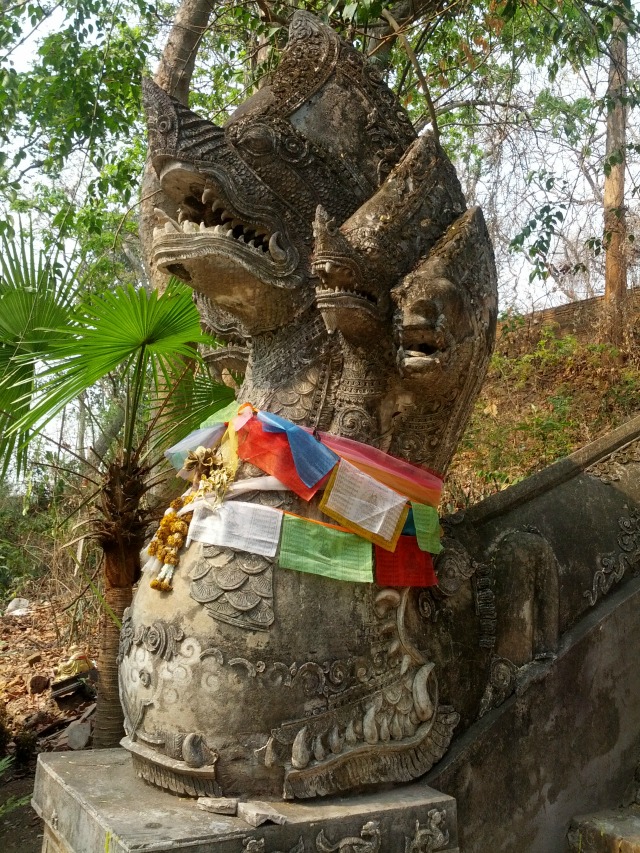
Naga in Wat Oomong
Buddha after enlightenment, sat under a tree. It started pouring so Muchalinda, the serpent spread out its hood to form an umbrella over Gautam Buddha.

The pit at Wat Jed Yod
The pit above signifies the pond where the serpent lived.
Naag or naga at entrance to Wat Doi Suthep
Sometimes the naag has mirrors and shiny stones- the purpose is to shoo away the evil spirits who may come to disturb devotees during meditation. They would look at themselves on the shiny surface, get scared and go away.

Dharma chakra in Wat Doi Suthep
Dharma chakra or the wheel of law is one of Buddha's symbols. The eight spokes signify following the "eight fold path".
It may stand by itself or sometimes is flanked by two deers on either side, a very common site in wats in Nepal. In the above picture it has chofah on either side.
There is definitley much more than what I cover here but even the knowledge about these terms helped me understand a little about the wats I visited.


