Monday, April 11, 2022

Wat Rung Khun, White temple, Chiang Rai

 Any tourist visiting Chiang Rai does not miss going to see this temple. Even we belonged to that category. We reached Chiang Rai at around 10:30 am, a short flight from Bangkok. Checked into the hotel, packed our bag for the day and off to Wat Rung Khun. It was the first wat we visited. We had at least 4 places planned for the day so didn't want to waste any time.
Around 45 minutes drive, we were in front of the temple. It was not as big as I had visualized it to be. More buildings are being constructed, read there were going to be nine buildings, so maybe by the time it is completed, it would be a massive temple.

About the temple:
The architecture of this temple is the brainwork of Buddhist Thai painter, Chalermchai Kositpitat. The earlier existing wat in its place was in dire need of repair. Chalemchai, a native of Chiang Rai came forward to give it an entirely new look and interpretation of his work. The work on building started in 1997 and according to the artist, it shall take many more years to complete. 

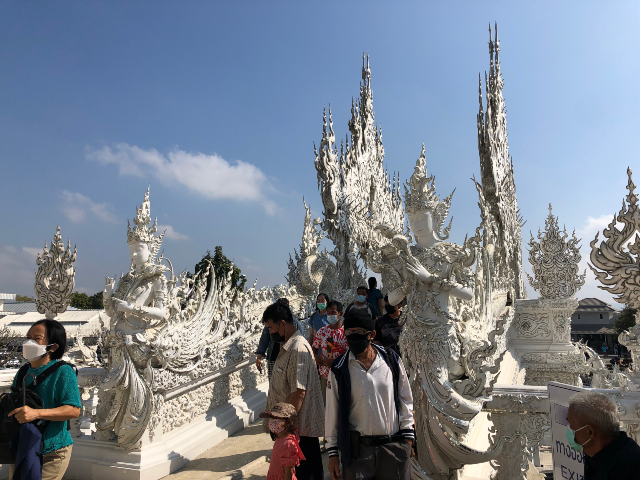
The building is made in white with pieces of mirror on it which makes the place glow in sun. According to the artist, white stands for purity and the mirrors represent righteousness or dhamma.

The art work is different and nothing like the wats we are used to seeing. Being traditional in my thinking, the interior of ubosot took me some time to understand the architect's point of view.
As one goes through the temple, one wonders the symbolism in architecture.

White color and use of mirrors: White signifies purity and mirror has been used as a symbol of Buddha teachings which shine in the sun, thus spreading its light everywhere.

Bridge crossing over outstretched hands: One gets over the cycle of rebirth by crossing this bridge which leads you to Heaven.

Giant tusks on either side: these represent the mouth of desire and we need to avoid not to fall into that trap.
Apart from these, there are many things the architect has added to his imagination, I shall try to cover them and see from his point of view.

There is no entrance fee for Thais, foreigners pay 100 Baht.
The temple deviates from a normal wat in its decor and representation.
hanging heads welcome the visitors, something different
does the alchohol bottle mean that we abstain from drinking?
another tree
bell on side of temple

The bridge of the cycle of rebirth:
Hindu and Buddhist philosophy strongly believe in rebirth. A person is caught in this web of rebirth by succumbing to all the worldly desires. Let me try to explain the significance of what I have understood.
Two giant tusks represent the mouth of demon which lures you in this wordly pleasures, that is why they are not the bridge but below on its side.
Crossing the bridge leads to the Gates of Heaven.
Below the bridge, are hands coming out representing worldly desires like lust and greed. We get caught in whirlpool of these worldly pleasures and are unable to reach enlightenment. The white semi-circle represents the earth in which we live.
You have to be strong enough not to succumb to any temptation and desires.
On looking carefully, you just see one finger with red paint on the finger. This symbolizes that knowing physical beauty is superficial, we go for it.
entering the "Gate to Heaven"
once you cross the small bridge, there is no turning back.  The entrance to the bridge over the ocean is guarded by two dvarpala or yaksha or temple guardians on either side.
Yaksha here, have wings
demons on the bridge
The monsters or demons signify the causes of sorrow.
tail of naga
albino koi fish to go along with the temple theme
The fish are said to be imported from Japan.
There is a pond below the bridge which represents the great sea or the "Sithandon Ocean". This is ocean from where the milk of elixer came out.
ubosot, hatstadiling on bargeboards
Since no one is permitted to come back, you take off your footwear, take them along inside the ubosot and either place them in shoe rack in the corner or carry them with you. Philosophically, once you enter heaven there is no coming back.
  • The stairways: 3 parts of the stairs means the three characteristics of existence, namely impermanence (anicca), suffering (dhukkha), and non-self (anatta)
Hatstadiling, a mythological animal which has head and trunk of an elephant, comb of a cock, body of a lion and wings like a bird. It is said to inhabit the forests of Himavanta, in Himalayas.
Hatsdaling is also referred by other names: nok hatsading, nok hatsadi, nok hat in Thai.
 The highest point represents Mount Meru, which mythologically is the center of universe.
kinnars, half bird and half human at the end of bridge
As you climb up the ramp, there are four lotus marked, which represent the "Four stages of Enlightenment". They are said to be Sotapanna, Sakdagami, Anagami, and Arahant.
Buddha image in meditative posture above the entrance to ubosot
three-tiered ubosot
Boddhisattva at entrance to ubosot
After this point, no photography would be permitted, I shall wirte what I see inside. There are many sites which have posted few pictures.

Inside the ubosot:
Straight ahead on entrance, you see multi-tiered image of Buddha. 
A white image of Buddha sits in Vitarka mudra, in which thumb and first finger touch each other. The three fingers point towards heaven with palms facing outwards.
This mudra symbolizes knowledge gained after reaching enlightenment. The image sits on a gold lotus.

Just below the above image, is another golden image in bhumisparsh mudra. On the wall behind the both images, is floor to ceiling painting of Buddha in gold.

The interior including the floor is orange-gold.
In place of usual paintings of Buddha or his life, are paintings of modern characters from Superman, Star Wars images, burning of twin toweres with faces of George W. Bush and Osama Bin Laden, also paintings of sorrow and pain in the world.

As one exits and turns to have a last look, you see an open mouth of a monster around the door you just entered into the ubosot, symbolizing that you have just entered out of monster's mouth into heaven.
structure on exiting ubosot, were not allowed to go in
naga at one side gate
Makar mouth guarding the temple
another hatsdaling in lawns

image on a gate
Looks like Khochasi, a mythological animal. Lion with elephant's trunk and ears.
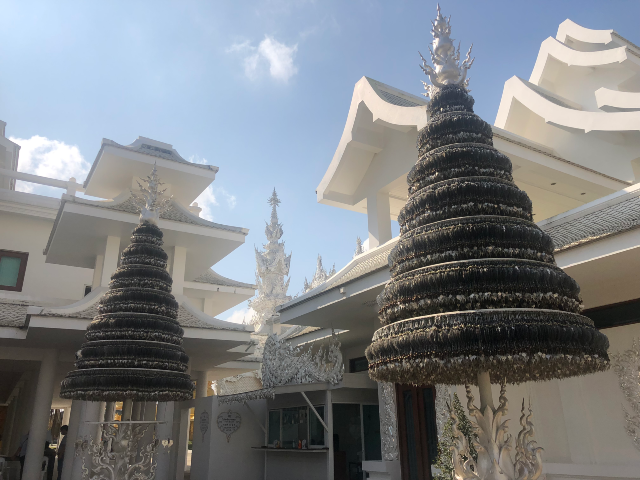
There is a corridor from which hang silver leaves from the roof.
Also, there is a concrete tree trunk from which hang silver leaves. Anyone wanting to make a wish, buys the leaf for 30 Baht and hangs it on the tree or on the roof of corridor hoping for the wish to be fulfilled.
Chinese zodiac signs
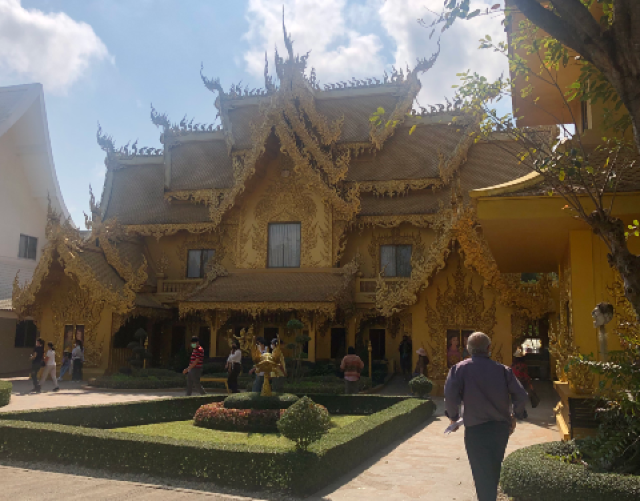
Ahha, one is surprised to see a golden building between white. These are the rest rooms.
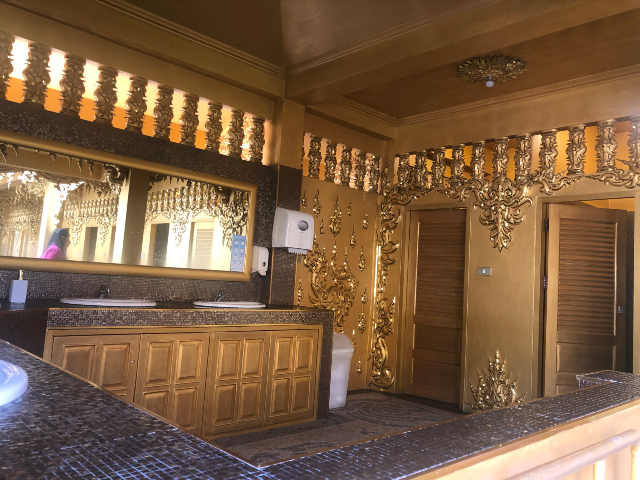
Gold color represents body and earthly desires.

inside of restroom
There is a golden tree in which are two images of Buddha.


turtle with wings
naga serpent at side entrance to ubosot

Honestly, the moment you enter the temple complex, it gives an impression of walking into a theme park. For a traditional person like me, it took some time to understand the architect's point of view.

Timings: 8:00 A.M. - 5 P.M.
entrance: free for Thai nationals, 100 Thai Baht for foreigners

Thursday, April 7, 2022

Chiang Rai, Thailand

We had been to Chiang Mai earlier and this time we planned on going to Chiang Rai. When I look back, I realise that four days were too less. There have been so many places that we wanted to visit but had to decide on our bucketlist.

Welcome to Chiang Rai

Old Clock tower:
Sadly, looking at the old clock tower gave me a similarity of new generation taking over the older generation.
Now situated at a T-junction of Uttarakit Road and Suk Sathit Road, the white clock stands with a Rotary club logo on one side and Kodak on the other side.
Before I visited Chiang Rai, on looking for directions, I always assumed that it would be from the old clock tower since it had been installed much ealier. But, on reaching the place, I realised all my directions were from the new Golden Clock tower not the old one.

Old clock tower
This clock was the earliest clock tower in Chiang Rai and was standing where the new clock tower stands now.
In 2006, Chaloem Chai Kositpipat, who designed the White Temple, planned the Golden Clock Tower on the crossing of Banpha Prakan Road, Suk Sathit Road and Chet Yod Road resulting in relocation of the old clock tower.

Golden clock tower:
Golden clock tower
It is a matter of choice, some people might get awed seeing all golden clock tower. Maybe, I had some other picture on my mind so when I saw it, I thought, oh, is this the one everyone's been talking about?
The construction definitely must have cost a lot but to me it looked overdone.
The lamp post on this road seem to match the pattern of this clock tower.


My husband was in no mood to to witness the sound and light show that is supposed to be one of the highlights of Chiang Rai now. I wanted to see so that I don't regret it later. The clock chimes everyday at 7 PM, 8 PM, and 9 PM.

I do not know, why I had thought it to be a sort of laser show but the lights which fall on the clock tower change colors from blue to red to yellow. The video above shall give some idea of what it is. I tried to merge two-three videos together.
In my honest opinion, I would say if you have time and are having quick bites around the corner, it is not a bad idea to see it once.
We went during the covid times, so the place was not that crowded but I believe it gets crowded with traffic coming from all sides around the roundabout.

Later, after the clock chimes are over, a Thai music plays.

Annual Flower festival at Chiangrai Tung and Khom Park:
If you are a lover of flowers, then this is the place you should not miss visiting. The entry is free and one can stroll between the flower beds.


flowers in full bloom


Each flower has a sign with its scientific name and a Thai name
canopy of orchids
The flower show is held every year between late November and extends to February

King Mengrai Monument:
King Mengrai (1262-1311) was the founder of Lanna Kingdom and is held at high esteem by the people. They come here to pay respects, offer flowers, burns joss sticks and also offer food.

The King's statue has three large golden tungs (Lanna flags) behind him.
King's silhouette at dusk
city wall
Places to relax and eat:
There are ample cafe's and eating places in Chaing Rai. My husband's favorite relaxing place was the milk bar by Thai-Denmark, very close to Wat Ming Mueang.  It suited us both, he relaxed with a cup of coffee and I used to walk across to the wat.


We had Khao Soi the previous day, was so hungry that forgot to take a picture. The next day we decided to have chicken topped with crispy noodles.
we were amused by "Starbears", though thorougly enjoyed the tender coconut with its water.
As dusk approached, we saw plenty of birds flying in the sky. My first reaction was of bats but after hovering for some time they all settled on the electric wire on roadside.

Jerdon's Bushchat or brown strike
bidding goodbye to Chiang Rai

Rules which need to followed when visiting a temple or a wat:
Like all temples, certain decorum needs to be adhered, though I have observed many tourists flouting the rules.
  • the dress worn should be below your knees and the shoulders covered
  • shoes need to be taken off when entering the place where the image of Buddha is kept
  • hugging and kissing inside the wat is not permitted
  • drinking and smoking not permitted in the temple complex
  • when sitting in inside the chapel, feet should never point towards the image