Sunday, April 17, 2016

Candi Sambisari, Yogyakarta

In 1966, a farmer's hoe hit something while tilling his land. It was a stone from a buried temple. Excavation revealed plenty of such stones. It took almost 21 years to assemble and find the 9th century temple buried 5 meters under volcanic ashes of Mount Merapi. Since the temple was buried, after excavation it is 6.5 meters under the ground level. Built during the Mataram Kingdom, the temple is very small and there seems to be lot burried underground.

It would be a good idea to visit this place going back to Yogja after doing Prambanan temples. A short diversion from the main road through villages and you reach this temple. Since one is so used to seeing a temple at ground level, you start wondering where the temple is. Start walking and you see the temple below the ground level.

picture taken from the south direction

Pictures during excavation

pictures taken during excavation

We decided to visit the information centre before going down to see the temple. 

There are four entrances on four cardinal direction and a flight of steps leads to the entrance. There are two boundary walls surrounding the temple.  One has been completed while the top of the other one is seen.
As as the temple faces west, it is a good idea to descend from western side, cross over a small "moat" and enter the temple complex. There was obviously no moat in the original plan. It has been made to stop the temple from flooding since all the water would go down the slope.

picture taken from north side


Inside the temple wall, there are 8 shivlingas. One each in the four cardinal directions and four at the four corners. So this was a Shiv Hindu temple.

Shivlinga

entrance to temple
The 7.5 meters high temple is guarded by a pair of makars at entrance. The top of the entrance is devoid of kaal mukh and there is nothing there. The side walls of the temple are devoid of any reliefs or decorations.

Makars on both side of steps 

I have written in detail about makar and kaalmukh in my post on Candi Prambanan, Yogyakarta

makar supported by a gana
Gana (गण ) are the attendants of Lord Shiva.

empty alcoves on both sides of the main sanctum

The empty niches apparently had images of Nandi and Mahakaala.

entrance to sanctum sanctorum

kaal mukh overlooks the entrance to this place.


A 1.18 meter high yoni stands over which is a 2.9 feet Shivlinga.


Yoni is supported by a naga at its base, the style is so much like the ones at Prambanan temples, so the temple is believed to have been built around 812 A.D., the same time period when the Prambanan temples were built.


Coming out into a small rectangular circumambulating area, there are 4 square bases in the four corners and 8 stone circles . It points that there was a roof which stood on top of the temple and the bases supported maybe wooden pillars.


The temple side wall is decorated with simple etching only at the top.


Going around in a clockwise direction, which is always the correct way to do in a temple is an image of goddess Durga as Mahisasurmardani under a Kaalmukh. I have mentioned about Durga, Ganesha and Agatsya in  Candi Shiva, Prambanan temple.
The sides show etcing on stone. Small steps lead to the goddess.


Moving ahead is Lord Ganesha. Here also two small steps can be seen in front of the deity with stone etching on the sides.


In the south direction is an image of Agatsya. All these images are better sculpted at Prambanan.


Coming out of the temple, there are three Perwara or guardian temples in front.


The perwara temple in the centre has a square base supported by naga on four sides and a round base of lotus. Probably Nandi, Shiv's mount sat here but actually what purpose it solved is not known.
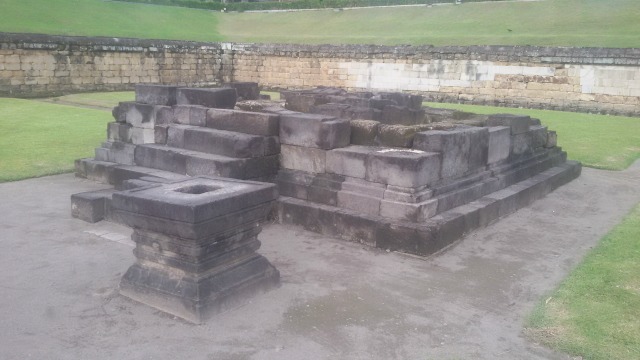

There is a yoni in front of one perwara temple, probably the Shivlinga is missing.
The perwara temples have an entrance with steps leading to a chamber with walls on the sides but without any roof.

marked pieces which were once a part of the temple

more marked pieces


Looking at the number of marked stone pieces, there is more to this temple the puzzle of which needs to be worked on.

There is more of this temple or similar temples underground. Maybe, in future we may see more of it.


Sunday, April 10, 2016

Wat Umong, Chiang Mai, Thailand

We planned on going to Wat Umong first as this place is situated very close to the base of the mountain. Oo mong can literally be translated into tunnels in Thai. The full name of this Wat is Wat Oomong ( Oo mong)  or Umong Suan Puthatham.

This 13th century wat was made by King Mengrai, first ruler of Lanna Kingdom. It has tunnels under the mound of its bell shaped stupa. It gets covered with moss and vines specially during the rainy season.

The narrow path leads to monks quarters, take the other path to reach temple entrance.

steps leading to temple

On the sides of these steps, are fierce looking Dvaarpalas or temple guardians.

Dvaarpalas (Dvaar: a door, Paal: protector) or temple guardians who protect the  place inside. They are usually fierce looking demon like figures but sometimes may also have an average human like figure. They hold a weapon, usually a mace, in their hand.
The presence of dvaarpalas is very commonly seen in the temples of India, Sri Lanka, Bali, Java, Cambodia and Thailand.

There are three entrances, a big one in the center and two small ones on either side. A replica of Ashoka pillar at Sarnath, India stands with its symbol of 4 lions facing back to back on an inverted lotus and the wheel of Dharma on top and below.

Ashoka pillar replica
The symbols signify:
lions for power, the Dharm chakra with 24 spokes on top signifies that Dharma or righteousness
[not religion] is always at top.

inscription stone near the pillar
Ashoka, the great Mauryan dynasty king ruled India in 3rd century BC. He was a devout Buddhist and helped in spreading Buddhism across the Indian subcontinent and Sri Lanka. There were many of these pillars erected by Ashoka which were inscribed with Buddhist teachings.  Very few of them remain now.

 view of the three tunnel entrances

The 700 year old temple was made by King Mengrai to honor a monk (in the picture above) who wanted to get away from the hustle of city and go off into forests for days to meditate in the quiet surroundings. The King built this temple with tunnels apparently painted to resemble forest to keep the monk give a feel of forest and solitude. The restoration and plastering over a period of years makes it impossible to see any of those now.
entrance to center tunnel

The tunnel leads to an altar on which sits a golden Buddha.

Image of Buddha at the altar
The two tunnels open to the rear side and criss cross the central tunnel.

While going down the tunnel, you see niches on the sides with small Buddha images kept inside. They apparently were places to keep lamps in the times when there was no electricity.

Buddha image at the end of one tunnel
There is also a mat just in front of each image for devotees to sit and meditate.

Exit the tunnels and turning left leads to Chedi or stupa.

A flight of steps with mystical naga leads to chedi.

close up of naga

bell shaped Chedi 
Passing through the chedi, walk to the end, go down the steps and keep walking straight past the end of tunnels, follow the trail and on the right side is a black stone Buddha.

It pains to see the emaciated image of Buddha in this stage. Gautam Buddha in the last days of his life not only renounced world but stopped eating as well. He became weak and bones showed through his body. But deep in meditation, he did not worry about anything.
This Lanna style of architeture existed for a very short time and there are very few remaining examples now.

On the sides are the monks living quarters, walk towards that and turn to your right. A huge collection of damaged Buddha statues is seen there.

As I have already mentioned, it is objectionable and improper to keep a Buddha head so this place apparently was started by a devotee who rescued a Buddha head from a nearby place. Since you cannot worship or throw the damaged piece, he decided to keep it under a tree. Over a period of years, it became a practice for people to put their damaged or broken Buddha images here.

 damaged seated Buddha

 more damaged pieces

 more of these...

small pieces kept under a tree
Very close to the exit gate is a rest room. Notice that you need to remove your footwear there and change into slippers provided.

Points of interest in this wat:
  • Entry is free
  • Criss cross tunnels at the end of which are images of Buddha.
  • Ashoka pillar
  • bell-shaped chedi covered with plants at places
  • black emaciated Buddha statue 
  • a congregation of damaged Buddha statues
  • for those interested, a pond where to feed fish.
Some other wats: Wat Chedi Luang, Chiang MaiWat Phra That Doi SuthepWat Sri Suphan, Chiang maiWat Jed Yod or Ched YodWat Phra SinghWat Chiang Mun, Chiang Mai, ThailandWat Suan Dok Mai 

Friday, April 8, 2016

Some terminology associated with Buddhist wats in Thailand

Since I am going to write about my visit to some Chiang mai and Bangkok wats, I thought it would be a good idea to explain the terms I would be frequently be using in my upcoming posts. I am not an authority and there might be so much more to what I write but it made me understand a little about the temple layout and the terms used.

Before I start briefly explaing there are certain rules to be followed while visiting wats that are good to know. Keep in mind that wats are not tourist destinations but are holy places. You would see such signs outside wats. It is our duty to follow them.


Wat:

Angkor Wat, Cambodia

 Wat Phra Kaew, Bangkok

Wat Pho in Bangkok

This is the term used for a temple in Buddhist countries as Thailand, Cambodia and Laos.

Inside a wat complex:

Apart from the prayer building or hall, there are monks quarters, assembly halls, ordination hall, dining hall, library, sometimes a school. There might also be a bodhi tree or a sala tree, all associated with the life of Buddha.
Let me try to explain each term.

Viharn or Vihan or Wiharan (Assembly hall):


Viharn or Wiharn is an assembly hall. It comes from the word vihara and always faces east as this was the direction Buddha faced at the time of enlightenment. This hall has images of Buddha and is used for meditation purposes, prayers and preaching services. A wat may have more than one viharn.
One important feature of a vihan is that it has entrances on the four cardinal directions.

Ubosoth:


Ubosoth or bot is the ordination hall for the monks and is one of the most important part of the temple. This means that the new monks take vows or get indoctrined here to enter the life of a monk.
It looks very similar to a viharn but this is mainly used for ceremonies or rituals associated with monk's lives. Another differntiating feature from a vihan is that it has only one entrance.

If the ubosoth does not have a Buddha image, it may be closed for public entry.

Sign outside ubosot in Wat Sri Suphon

Some wats do not permit the entry of women into their ubosoth as you can see above.

Sema stones:


a sema stone at Wat Yaichai Mongkhon, Ayutthya

Sema or Sima taken from Sanskrit word which means a boundary. There are eight such stones around an ubosoth. This is bht boundary of ubosoth and mark the sanctity of this place. A ninth one however is put under the main Buddha image at the time of construction.

Chedi:


Chedi or stupa comes from the word Chaitya. It is a reliquary tower and represents Mount Meru, the sacred mythical mountain which in Hinduism, Buddhism and also Jainism is the center of all worlds, may it be physical or spiritual. A chedi contains a holy relic, or ashes of a king or monks or even images of Buddha enshrined inside.

The name of the wat  gets linked to the relic which is enshrined there. It is common to hear Phra or Sri precede the name of a wat.

Phra: means holy or sacred, a title befor a monk or a wat. So any place or person which is holy has Phra before the name. Examples: Wat Phra Singh

Sri or Si: Majesty as Wat Sri Suphon

Phra That: When this is added to a wat, then that place has a holy relic, ie associated with Buddha. It may be a tooth, hair, bone. Example: Wat Phra That Doi Suthep

Mahathat (or Mahat in Sanskri) : maha: Great. So a wat containing a great holy relic has sthis preceding its name . Example: Wat Mahathat Yuwaratrangsarit.

Prang:


Prang in Wat Chaiwatthanaram, Ayutthya

Prang is a central tower with a soft tapering top. It was influenced by Khmer architecture and you come across many wats with a prang in Ayutthya. Wat Arun in Bangkok also displays a prang.
Prang has an entrance on one side.

Hor Rakhang:

Rakhang or bell tower has a huge bell inside. The clang of this bell summons the monks to their daily activities.

Sala tree:


One of the addition to a wat is Sala tree. Also known as canon ball tree, this tree is important as Lord Buddha was born under a Sala tree in Lumbini on a full moon day in the month of Vishakha. A Ashoka pillar (circa 300 BC) stands today at the place of his birth in Lumbini.

Bodhi tree or Bo tree:


This tree is held in high esteem in Buddhism. Lord Buddha attained enlightenment or Nirvana meditating under this tree in Bodh Gaya.
The tree in a wat will have a platform on which is a seated Buddha. There may be monks also near it.

Hor trai:
This is the library in a wat complex where Buddhist scriptures are kept.

Mondop or Mandapa:


It is a square pavilion with a spired and tapering roof. It is intricately carved and contains a Buddhist script or an image of Buddha.

Chofah:


Chofah are spiral tapering structures on the roof. They signify the head of Garuda, the mount of Lord Vishnu. They are very typical of a Thai and Cambodian wat and lend a aritistic beauty to the wat. I have made arrows to show them clearly. 

Another important feature is that the tail of chofah is said to symbolise serpent or naag. In mythological terms, Garuda amd serpent cannot stay together and are enemies of each other, but only in a wat can they exist in complete harmony with each other.

Naga or Naag:


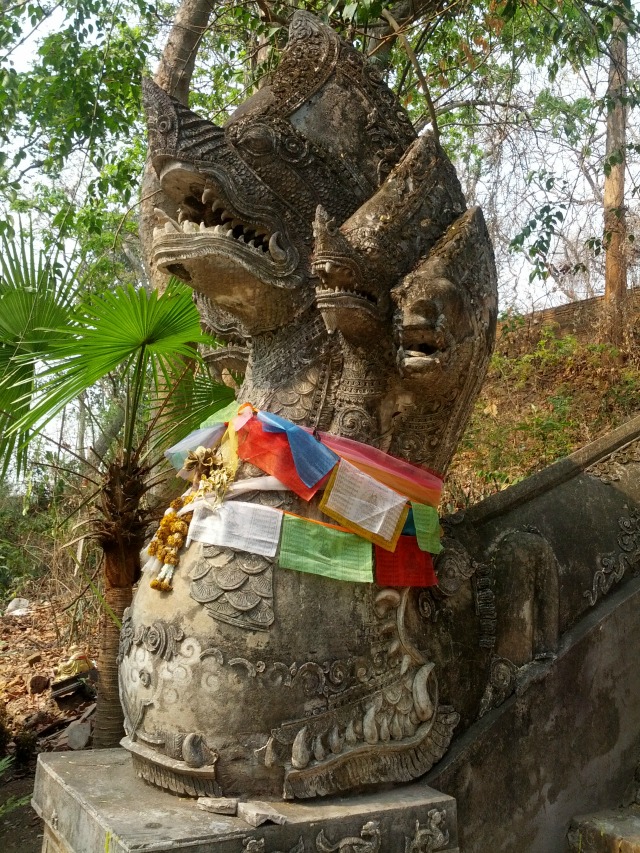
Naga in Wat Oomong

On either side of a steps leading to chedi or entrance to a viharna are mystical beings referred to as naag.
Buddha after enlightenment, sat under a tree. It started pouring so Muchalinda, the serpent spread out its hood to form an umbrella over Gautam Buddha.

The pit at Wat Jed Yod

The pit above signifies the pond where the serpent lived.

Naag or naga at entrance to Wat Doi Suthep

Sometimes the naag has mirrors and shiny stones- the purpose is to shoo away the evil spirits who may come to disturb devotees during meditation. They would look at themselves on the shiny surface, get scared and go away.

Dharma (Dhamma) chakra:


Dharma chakra in Wat Doi Suthep

Dharma chakra or the wheel of law is one of Buddha's symbols. The eight spokes signify following the "eight fold path".
It may stand by itself or sometimes is flanked by two deers on either side, a very common site in wats in Nepal. In the above picture it has chofah on either side.

There is definitley much more than what I cover here but even the knowledge about these terms helped me understand a little about the wats I visited.