Myazedi is in Myinkaba village in old Bagan very close to Manuha temple. The gilded stupa, is made of square tiles. The pagoda was under renovation when we visited. It was covered by a cloth all around.
entrance to pagoda
On either side of entrance is a pair of chinthes who guard the pagoda.
History of the pagoda:
Myazedi, which translates to Jade Pagoda was built by Prince Rajakumar or Yazakumar in the early 12th century. Kyansittha married Thanbula when in exile but left for Pagan after the death of Anawrahta on insistence of Saw Lu, his half-brother. He was not aware that his wife, Thanbula was pregnant with Prince Rajakumar at that time.
Kyansittha ascended the throne in 1084 and had three wives in addition to Thanbula whom he had forgotton.
Kyansittha nominated his daughter's son, Sithu I, later known as Alaungsithu as crown prince. Thanbula came to meet Kyansittha after many years with her son, Rajakumar who had the lawful right to be the king. As the King could not go back on his words, he gave Rajakumar some land. Thus, the only son of Kyansittha remained a prince throughout his life .
Rajakumar was a pious person who donated everything and constructed Myazedi.
Myazedi inscription is a stone which tells about Kyansittha and Rajakumar. It is located in a small room protected by iron grill all around.
chinthe guarding the entrance to pagoda
The stupa is made up of square tiles topped by a multi-tiered hti.
The stupa is on top of three receding terraces. The topmost terrace has four small golden htis on its four corners. The second tier has four chinthes on its four corners and the last terrace also has stupas with hti but constructed differently.
Buddha image in pagoda with donation box on the side
very different style of Buddha image
The image is in Bhumisparsh mudra (earth touching pose)
frescos on ceilings
small temples in alcoves with golden htis
image inside the niche
shop selling sand paintings
Most of the pagodas and temples have people selling sand and stone paintings. Bagan is the place to buy sand and stone paintings.
Southern face of Gu Byauk Gyi temple
Two structures, one with a bell shaped stupa and another with small htis on top behind the pagoda.
image of Buddha in pagoda behind Myazedi
place for pouring water on Buddha images on your birth day
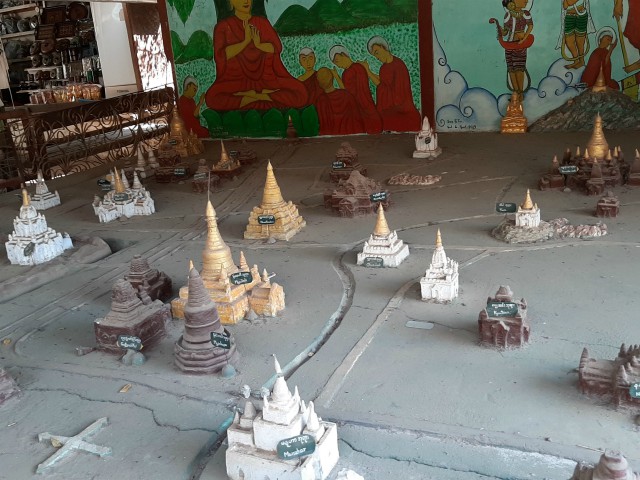
In a corner are models of important pagodas and temple.
Myazedi inscription:
There is a stone incription in four languages in a small room beside the pagoda. It tells the story of how King Kyansittha chose King Sittu, later Alaungsittu to be the king instead of him.
signage by the road
UNESCO stone
the original stone tablet
the original stone tablet
In a small room beside the pagoda, enclosed inside iron grills is the quadrilingual inscription stone. It is the oldest inscription stone in Burma, inscribed by Prince Rajakumar in 1113.
inscription stones peiced together from fragments
The stone gives a detailed account of Kyansittha and how his half-sister's son, Alaungsithu was chosen to be the future king instead of him.
This stone has inscription in four languages on its four sides-- Pali, Mon, Burmese and Pyu.
Gu Byauk Gyi temple:
To the west of Myazedi, in Myinkaba village, is Bu Byauk Gyi temple. It is a Buddhist temple built by Prince Yazakumar or Rajakumar in 1113 after the death of his father, Kyansittha.
The temple contains very well preserved frescoes inside. They have been fenced so that tourists do not touch them. They are said to be the oldest original paintings in Bagan.
Inside the south entrance is a huge image of Buddha. The faint lighting makes it difficult to see and appreciate the beauty of image and frescoes. There is hardly any artificial light and one has to strain their eyes to appreciate the beauty of frescoes.
It is not permitted to take cameras, mobile phones inside so that the flash from cameras do not spoil the frescoes.
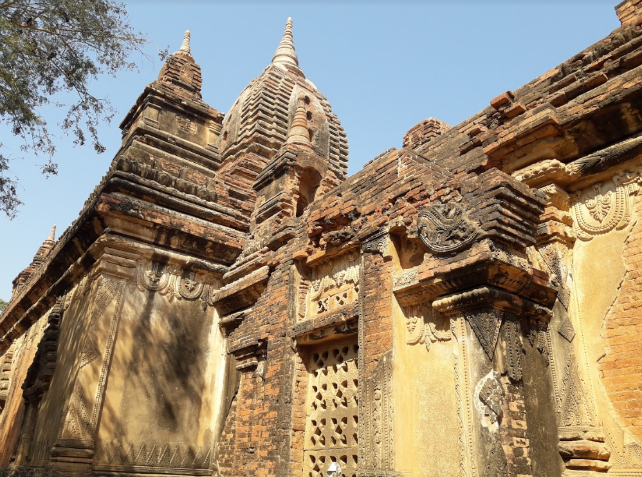
The fine stucco work on the temple's exterior can be see at places and is in a good condition.
Beautiful windows of Bagan time are seen.
The temple tops in an Indian style shikhar with a spire at top.
Stuccos on outside wall
If time permits, Gu Byauk Gyi temple is worth a visit.

 We went around noon and the hot blazing sun burnt our feet as we ran up the steps without any footwear. In order to reach the top to some shade, I forgot to take pictures. This, I realized when I started writing this post.
 The temple stands on a raised platform and is made of wood.