Showing posts with label hair relic. Show all posts

Tuesday, October 12, 2021

Shwe San Daw Pagoda, Bagan

With a height of 328 feet, Shwe San Daw is one of the highest pagoda in Bagan. It used to be a favorite spot for viewing sunrise and sunset. Many factors as aging building, earthquake in 2017 has restricted tourists from going to terraces. It is not only this pagoda, there are many temples in Bagan where the visitors are forbidden to go up.


History and facts about the pagoda:
  • The pagoda was built in 1057 by King Anawrahta
  • King Anawrahta is said to be the founder of Bagan kingdom as only after he came to power did Bagan become a prosperous empire
  • The king  converted to Thervada Buddhism and wanted to spread the religion. He requested the Mon King of Thaton, Makuta (later renamed Manuha) for a copy of Tripitaka. When the later refused, King Anawrahta invaded, defeated and captured Manuha. He brought him to Bagan and kept him in captivity.
  • King Anawrahta constructed plenty of pagodas to gain merits
  • Shwe San Daw was built outside the city walls of Bagan to provide divine protection to the city.
  • the pagoda was one of the first of its kind to have steps on all four sides going up to the round base of stupa
  • the stupa was built to enshrine a sacred hair of Gautam Buddha which King Anawrahta got from Manuha after he defeated and conquered the Mon Kingdom of Thaton
  • since, it enshrines a hair relic, the pagoda is named as Shwe San Daw, meaning "golden holy hair"
  • All the four corners on all five terraces have images of Ganesha, known as Maha Peinhne in Burmese.
  • Hinduism was the religion before the arrival of Buddhism
skyline in the evening, Thatbyinnyu temple can be seen straight ahead
a small stupa nearby
A flight of steps lead to the base of round stupa on all the four sides. The purpose of steps on all four sides is not understood. Maybe, it was to give a symmetry to pagoda.
The entry is now prohibited. The upper terraces provided a very good view of sunset and attracted a lot to tourists at that time.
The Pagoda is made of red bricks and that was its original color till 1957 when the temple was renovated and in order to preserve the brickwork, it was plastered and colored white.
Again in 1990, when the temple was restored, it was simply white washed.
 part of damaged chinthe in one corner of pagoda
The pagoda has five terraces in receding order. A stupa tops the terraces with a jewelled hti, umbrella.
The hti now is not the original, as it toppled during 1975 earthquake.
The terraces had terra-cotta plaques with Jataka tales, which depicted incidences about the previous lives of Buddha. Time has washed everything away and only the bricks and empty spaces can now be seen.
The corners in all the five terraces have statues of Ganesh or "Mahapeinne" as many Hindu deities were worshipped before Thervada Buddhism arrived. The pagoda is also known as Maha Peinhne or Ganesha pagoda.
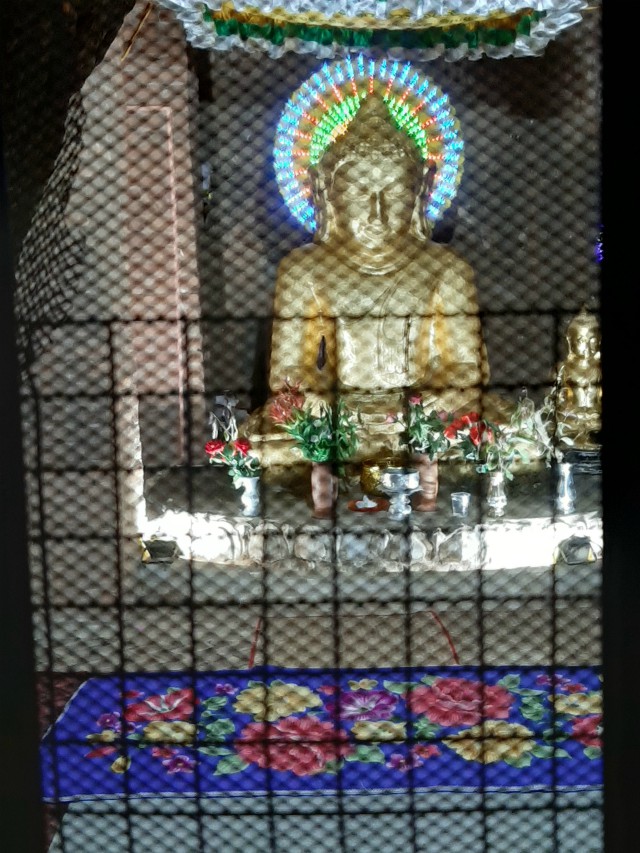
On the eastern side of temple is a small temple with a bronze Buddha image. There is a screen in front of the image so had problem getting a good image.

Lawkahteikpan Pahto:
On the southern side of pagoda is the Lawkahteikpan Pahto.
The temple has a Mandalay style bronze Buddha image. It is said to be 100 years old. 

Shinbinthalyaung temple:
On the west of Shwesandaw Pagoda is a rectangular building which houses a 70-feet long reclining Buddha with his head towards the south. The inside of building is dark with small windows.
rectangular building housing reclining Buddha
reclining Buddha, image is said to date 11th century

fresco still intact
 a devotee touches the feet of Buddha
 the fresco work is said to be original Bagan work and are in quite a good condition
 Buddha image in niche opposite reclining Buddha
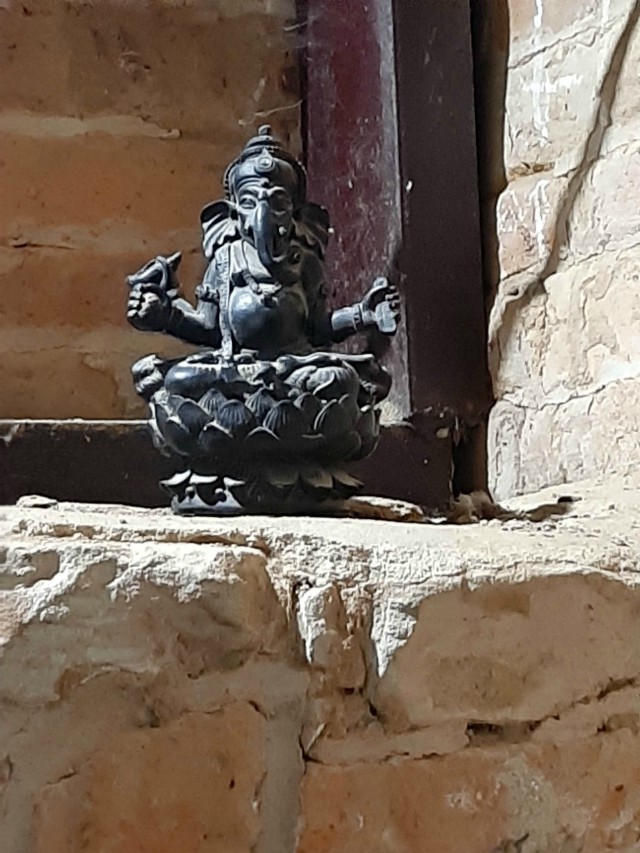
Ganesha or Maha Peinhne image in a corner near the exit
pagoda at dusk
With five receding terraces and tallest pagoda, it is a must see place.

Wednesday, June 25, 2014

Visiting Colombo

What could have been a better timing to visit Sri Lanka than Vesak? The whole country is illuminated and there is festivity in the air.

Vesak is celebrated to commemorate the birth and nirvana of Gautam Buddha. It is both a religious and a cultural festival. It falls on full moon day in the month of Vesak or Baisakh, the lunar calendar coinciding with sometime in May of the Gregorian calendar. The festivities vary from 3 days to a week.
illuminated temple
lighted streets
The city looks beautiful with lanterns called vesak kodoo. Earlier, earthern lamps were used but gradually over a period of time, these paper or fabric lanterns have taken over.  I see most of them with a plastic covering so as to protect electric bulb from possibility of a short circuit in case there is a rainfall. The lanterns signify an offering to Buddha who delivered the message of Dharma.
lanterns in airport welcome passengers
lanterns in our hotel lobby
An array of lanterns
Beautiful innovative lanterns are made using coir, shells, jute and placed  around the city and attracts flocks of people to see the exhibits.  Competitions are also held and prizes given to the best entry.

Dansala:
Another important activity which takes place during these days is dansala or offering food or drinks to people. The word dansala is taken from the Pali word daan meaning charity or giving.  It is an ancient Buddhist practice of sharing food with everyone.

Not only is food given to people who visit the stall but is shared with all passerby and it is common to see people giving small packets through windows in a taxi. We both got a packet each too :)
dansala offering hot drink
Information regarding dansalas is advertised in newspaper.  I saw this on an online newspaper :

"A rice dansala organised by the Traders Association of the Peliyagoda Central Fish Market Complex, Sri Lanka Fisheries Corporation and Three-Wheeler Drivers Association will be held on May 15 and 16. 

A rice and curry dansela will be held at the Dasa Stores on May 15 from 12 noon to 12 mid night.  

Another vegetable soup dansela which has been organised by the Buddhist circle at Puhudela junction Hiripitiya, will be held on May 15 from 12 noon to 12 pm.  

A rice and curry dansela organised by the Puhdelgahawatta Buddhist Youth Club will be held on May 16 from 12 noon to 12 pm. 

13th May: An ice cream dansala is taking place right now at Sanga Raja Mawatha Colombo 10.

17th May: Academy of Multimedia Design & Technology will host an ice cream dansala at 4 pm at 20 Shrubbery Gardens, Colombo 04.

14th May: A sago dansala will take place on the 14th of May 7 PM - 12 AM at 217 High Level Road Nugegoda between Hotel School and the Louvre International School at Nugegoda."

Pandol or thorana or toran:
Torans are actually gateway or the main entrance.  But, in Sri Lanka numerous Pandols or torans are erected which illustrate a story from Jataka tales which are stories that  tell about the previous lives of Buddha. 
A Pandol on Galle sea face
The Pandol are illuminated after dark. 
picture of Pandol taken from train 
 Many people get together for bhakti gee or devotional Buddhist songs.
a group singing Bhakti gee
On the last day of festivities, we went to Gangaramaya Buddhist temple in Colombo.

Gangaramaya Buddhist temple:
This beautiful temple located close to Briera lake, in addition to being a place of worship, also houses a Buddhist school, a library, a museum which has many expensive gifts donated by devotees.
decorated elephant                    Dancers ready for procession              entrance to temple

Inside the temple, there are many huge statues of Lord Buddha. I have pasted some pictures below. 


Hair relic in the central glass dome with golden top
This temple has a hair relic which is only displayed on important days.

procession concluding Vesak
Its been ten days past Vesak, occassional lanterns and flags can still be seen hanging.  One year to go for the return of this lively festival.

I enjoyed looking at the golden peaceful posture of Buddha from my hotel window everyday.
Huge sitting Buddha in Sri Sambuddhaloka Vihara Buddhist Temple

Sri Sambuddhaloka Vihara Buddhist Temple
This temple is situated next to the huge Buddha statue and also has a library inside.
Independence Monument

close-up 

Independence Memorial Hall
In between the two lions, you see a door which leads to memorial museum situated in the basement.
Briera lake and top of Sri Sambuddhaloka Vihara Buddhist Temple

How can I conclude this post on Sri Lanka without any mention of Kola Kenda and hoppers?
healthy porridge to start your day
Kola kenda is porridge or soup which is taken for breakfast. The extreact of herbs is added to cooked mashed rice along with coconut milk.  This is usually taken with a piece of palm sugar called kithul.  In fact, there are varieties of herbs which can be used to make this healthy drink.  Welpenela, the write up of which you see in the picture above is also one of the herbs often used in making kola kenda. It is commonly called balloon vine.  I have pasted some pictures of herbs which I took from the vegetable section  in a supermarket. To avoid this labor intensive work, and till I find a shorter way to it,  I got a few packets of this drink in powder form.
I made a version of this using fresh spinach leaves paste.
some herbs used in kola kenda

Freshly made hoppers
Hoppers? I dont need to give any introduction to this dish.
stews for hoppers
They are usually eaten with a stew and a spicy chutney called  sambal. I also tasted the egg hopper where an egg is placed on to the hopper while it is cooking.  A perfect combination for a healthy breakfast.
But more than anything I immensely enjoyed honey hoppers. The batter had a taste of cardamom and the drizzle of honey gave it an awesome taste. Oh drooling.......
spicy and sweet sambals
A walk along the sea is always welcome and refreshing though it was very humid when we went.  It was waiting for monsoons to hit.  On weekends, this place is thronged by  people of all ages.
enjoying the weekend
snack time
kites soaring high !
Negombo is around 37 kms from Colombo and is one of the major cities in Sri Lanka.
sun set at Negombo beach

another click of sunset at Negombo beach
My holiday soon came to an end and with these beautiful memories, I return home. But, not without adding to my weight. I have put on 2 kgs and now I plan to get back to my routine and stop myself from indulging on any of those goodies :(