Showing posts with label pulpit. Show all posts

Wednesday, May 18, 2022

Wat Srikird, Chiang Rai

Visit to this wat, known as Sri Kerd, Sri Gird, Srikird was an unplanned one, I did not see its name on places to see in Chiang Rai. We were going to King Mengrai's Memorial, took a wrong turn and saw this wat on my right side. I came back to the hotel and searched for it. I did not get much details much about it, only that it was an old wat.
We decided to visit that place. To my disappointment, the viharn was closed that day so we decided to come back the following day.  Again the viharn was closed.  Since, we were leaving the next day, my husband went to talk to a monk and explained our situation. He said, he will come and open the viharn door for us.
The wat had few surprises for me. I will uncover all surprises:)

History of this wat:
  • The history of this temple is not very clear but possibly it was constructed in 1440.
  • The temple is named after the tree Sri Maha Bodhi, under which Gautam Buddha attained nirvana. The Thai alphbets does not have r-sound, so it became "sa-lee".
  • Depending on the prefix in conjuction with the word, Sri is equivalent to "Mr." in India, it is used with the name of god, kings, spiritual leaders etc. It is also another name for Lakshmi, goddess of wealth. Here, in the present context it means sacred, an honor which is given to a wat or a place.
  • The temple is located within the city wall, a little further away from the heart of city.
  • It is situated in eaternmost part of city so it used to get the first rays of sun.
What to see here:
  • coiled naga at entrance
  • entrance door to viharn
  • bronze image at altar
  • pulpit which is black and gold and is in a corner
  • ancient Lanna chest
main entrance guarded by golden lions
coiled naga at entrance

Viharn:
The beautiful viharn is designed in Lanna style and is guarded by coiled nagas on either side of its entrance.
The coiled naga balustrade were so pretty, I could not stop myself from taking pictures.
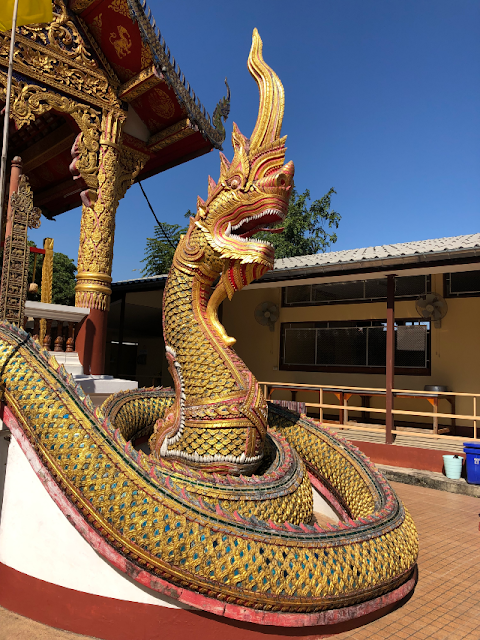
Most of the wats I had seen had naga balustrade, but here and also at Wat Chetupon, I was fascinated by the coiled naga balustrade. The naga coil and the tail extends upto the pillar of viharn.
Till the time, my husband comes back, I thought of admiring the entrance.
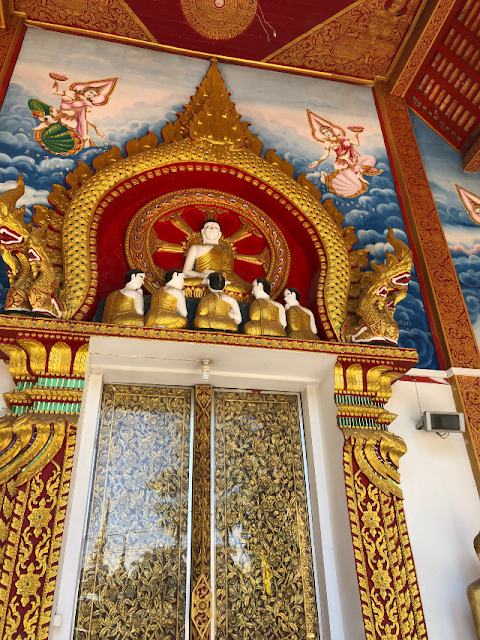
Buddha with dharam chakra behind giving his first sermon to five of his disciples is portrayed on top of the door.
This is the side door with dharam chakra encircled by naga on top.
gong on the side
red and gold pillar on side of entrance
beautiful carved wood work on door depicting forest in Himvanta, a legendary forest in the hills of Himalayas.
Buddha in different poses on the side of viharn
main altar

The principle Buddha image, big one in the above picture is the stucco image in local Lanna style in Chiang Sean Singh1 style where the body is plump, head has a topknot and has the shape of semi-opened lotus flower. Hair is in curls.

There is another image made of bronze, looks black in the picture. This is Phra Buddha Sri Ming Mongkol. The posture is in bhumisparsh or calling earth to witness. It is in Chiang Saen Singh 2 style. Here, the body is less plump, chest is not covered. Head and topknot rounder like closed lotus. It is situated in front of the principle Buddha image.
On looking carefully, you can see pulpit on our right side. This was the first time, I had seen pulpit in a wat.

Ancient Lanna pulpit:
The ancient Lanna pulpit is made of wood and gilded over with lacquer.
The head monk sits on the pulpit to teach Dharma

Ancient Lanna chest:
The trapezoid chest is made of wood gilded over with lacquer. It is used to store Buddhist scriptures.
Seeing the chest had escaped my eyes, so when I came out, I asked the monk about where the chest was. The monk took us inside and showed us the cabinet.
ancient Lanna chest
another view of chest
what a treasure inside!
The monk opened the chest and showed us the scriptures which were handwritten and in Pali.
I forgot to ask his name, sometimes when you are so excited looking at the treasure that you remember all these things as an after thought. My mother always used to say that I forget to ask the important things at the right time :(
Thank you phra, for showing us around.
He even read out few verses from the scripture and took pride in doing that.
ancient Lanna Dhamma book
cupboard to store Tripitaka
The three-tiered roof viharn was granted Wisung Khama Sima in 1970. This means a royal granting of land for monks to have an ubosoth or ordination hall to do religious rites.
Decorated windows with chinese zodiac signs.
The window too are made of carved wood with design of entwined sprays in Himvanta (Buddhist legendary forest). Notice, the window has a tiger on top.
entrance as viewed from inside
Chedi or stupa:
The Lanna style chedi rests on a square base with umbrella on four sides.
Two thewada figures stand in front in yai posture. Two monks, Khruba Siwichai sit in front at the base. Buddha image stands in an alcove.
On the top is a 5-tiered umbrella in receding order, which sits on a bell shaped base.
The chedi has golden umbrella on its four corners.
green and golden mom beside the chedi
bell tower
information board near the chedi
I saw this beautiful peacock on the side and wondered why a peacock and in Thailand? I still have not been able to understand the reason but one thing I was able to figure out after reading was that Buddhists believe in a peacock as a sign of long life or immortality. Peacocks generally eat stuff which is harmful to humans. Because of this thinking, Buddhists thought that peacocks could endure sufferings and live longer.
Dharma Chakra on the roof of other gate
Dharma Chakra
gnarring lions to protect the wat

Entrance fee: free
Timings: 0800 to 1700 hours, daily

Monday, April 25, 2022

Wat Phra Sing, Chiang Rai

Built in 1385, Wat Phra Singh is Chiang Rai's one of the oldest wats. It was built almost hundred years after the city was founded by King Mengrai in 1262. There is one Wat Phra Singh in Chiang Mai as well.
It is very common for more than one wat to have the same name.

History of Phra Singh Buddha:
  • According to the legend, the image is a copy which was housed in Mahabodhi temple in Bodhgaya(India), the place where Gautam Buddha atttained nirvana or enlightenment.
  • It reached Sri Lanka and then made its way to Nakhon Si Thammarat in Southern Thailand in 1307, on the western shore of Gulf of Thailand as that the first center where Sri Lankan style of Buddhism was practiced. Another legend says it was made in Sri Lanka in 157 A.D. and reached Thailand.
  • Since, the image came from Sinhala which was used for Sri Lanka, it came to be known as Sihing. It should not be confused with Singh which means a lion. How people came to be known as Sinhalese is going to side line of this post.
  • Phra Singh Buddha again made a journey from Sukhothai to Ayuthaya then to Khamphaeng Phet(Southern Thailand). 
  • Phra Chao Maha Proma took the image to Chiang Rai in 1388.
  • After Chiang Rai, it made its last journey to Chiang Mai, which was the new capital of Lanna Kingdom, where it still residing at Wat Phra Singh in Viharn Lai Kham, Wat Phra Singh
  • According to Thai culture at that time, it was believed that wherever this Buddha image resides, Buddhism would prosper. So, exact two copies in Sukhothai style were made plus one original but all claiming to be original. Then, two replicas were made. That makes four plus one images of Phra Singh.
  • The two latest replicas are enshrined in Wat Phra Singh and in Wat Chong Klang in Mae Hong Son, both these places in Chiang Rai.
  • Of the two replica images, one is inside Wat Phra Singh in Chiang Mai and the other in Phra Sihing Hall in Nakhon Sri Thammarat.
  • The one presumed to be original coming from Sri Lanka, Phra Phuttha Sihing is in Phutthai Sawan or Buddhaisawan Hall of National Museum in Bangkok. The image is a highly revered one and is placed in second place after the Emerald Buddha. It was brought from Wat Phra Singh, Chiang Mai in 1795 by Maha Sura Singhanat, brother of King Rama I, the first King of Siam.
History of temple:
  • Phra Chao Maha Proma was a prince who forcefully tried to take over the throne of Lanna Kingdom from his brother, King Mengrai who the rightful heir. Failing to get the throne, he went to Ayuthaya Kingdom, came back after few years along with the important Buddha image, Phra Singh.
  • The temple is said to be built in 1385, almost towards the end of Phra Chao Maha Proma who ruled from 1345 to 1400.
  • The wat was given the status of Royal temple of first grade in 1935 by King Ananda Mahidol(Rama VIII), the older brother of King Bhumibol Adulyadej (Rama IX).
entrance as seen from road
entrance guarded by lions

side entrance

Under a tree, on a circular platfrom are many Buddha images in different postures------Dhyaan mudra or meditative posture, bhumisparsh mudra can be seen in the above picture.
In yet under another tree very close to the other one are Buddha images in their famous mudras. We see going from left to right, contemplative posture, abhaya mudra, the reclining Buddha, Buddhapatra mudra, dhyaan mudra.
main entrace which was closed, faces the viharn

Viharn:
The typical Lanna style viharn has a multi-tiered roof and naga decorated bargeboards.

Built in 1385, the roofs are said to be the most beautiful in Thailand.
Makar disgorging Naga in front of Viharn
golden and green naga guard the entrance to viharn

The typical Lanna style viharn beautifully decorated with red and gold.
viharn is guarded by white and golden lions at the entrance door
The panels and doors are carved beautifully in wood with Lanna flower patterns, On top of the entrance are two Thewada figures, celestial figures.
On top of the side entrance on either side are seen two peacocks, two golden lions and one white and golden lion.
peacocks on top of side entrance, flower motifs decorate all around
the other entrance
Such art work are all around the viharn, just above the monks seating place. The above piece depicts a scene from Ramayana. It portrays, Ravana abducting Sita, Rama is on the hillock while Hanumana sits near the hillock.

The viharn houses Thailand's most revered and sacred Buddha image, Phra Phutta Singh or Phra Phutta Sihing, which is made of bronze and gold plated. 
It is 2.04 meter wide and 2.84 meter high, a little smaller than the original. The image is in bhumisparsh mudra and sits on lotus flowers base.
Chair for monk in sermon time
extremely beautiful pulpit in red and gold
Pulpits are hardly used these days, I have seen one pulpit in Wat Sri Kerd.

Ban Pratoo Luang:
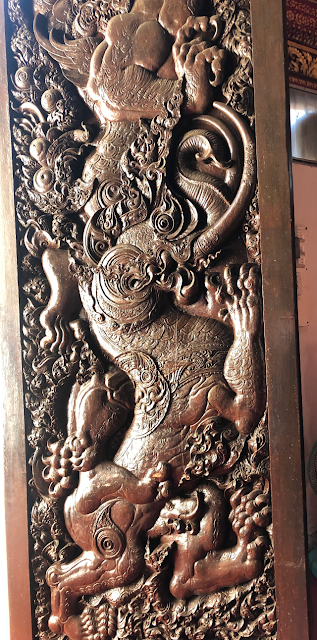
These are the beautiful carved doors athe entrance of viharn. The wooden work shows shows the artwork of a successful Lanna artist, Tawan Duchanee. It shows the existence of wind, fire, water and earth through four mythical animlas--- Garuda (air), singh or lion (fire), naga(water) and an elephant with tusks (earth).
The artist shows the relation between these animals and the elements earth, water, fire and earth that exist in our bodies.
windows of viharn with Chinese zodiac signs, thewada figures on sides
sema or sacred boundary stone
beautifully crafted windows
this window pattern is different than the one above

Ubosoth or Ordination Hall:
Close to viharn is the ubosoth or ordination hall.
The wooden building is small but very ornate and you gasp after seeing the beauty from inside.

the barge boards are decorated with naga and kinnar
the multi-tiered roof of ubosot has many honsa or hong or hongsa
thewada figure stands outside
first view of ubosoth
golden thewada figures on both sides of entrance


Here, was enshrined the original Phra Phutta Sihing or Phra before it was shifted to Chiang Mai. The original has been replaced by a replica now.


murals on walls of ubosot

decorated window

The walls of the obosot are decorated with murals all around.
more murals
mural showing the wat

Stupa:
The 14th century golden plated Sinhalese style chedi is located just behind the viharn.

It has a square base is surrounded by small stupa all around. There are four niches on four sides in which are placed an image of Buddha in each.
The chedi is topped by five-tiered umbrella.
There are umbrellas at four corners.
small stupa and lion
Buddha in one of the niches
another image of Buddha on other side.
reclining images beside the chedi
Phra Song Kad Jai or Kaccana under an umbrella
bell tower
side entrance
Pali school
Adjacent to viharn is the Pali language school. The Buddhist scriptures and Tripitaka are all written in Pali. The building has beautifully Thewada figures and the arch gate has naga serpents.
Monks kuti or living quarters
rear gate
Right opposite to Phra Singh, across the road, you see replicas of Royal Chariots which are displayed at Chalermprakiat Kanchanapisek Cultural Hall.
The golden chariots are decorated with beautiful naga serpents.

Opening hours: daily 0800 hours to 1700 hours
Entrance fee: free