Tuesday, February 16, 2016

Candi Shiva, Prambanan temple

This post is in continuation of  Candi Prambanan, Yogyakarta . The post was getting too long so I have split it in parts. Since, Prambanan is primarily a Shiva temple, I shall focus on the Shiva temple in this post.

Ruins of Shiv temple

 Shiva statue

This 37x37x47 meter east facing temple is the highest and biggest temple in the Prambanan complex. This is also the only structure which has entrances in the 4 cardinal directions and also houses 3 other small temples.

entrance to Shiva temple


The "Prambanan panel" with Kinnars at entrance. I have written in detail about this in my earlier post,  Candi Prambanan, Yogyakarta

Makars on either side of entrance

Shiv temple, other entrance

One doorway with an ascetic meditating under Kaal


Kaal at one of the entrances of Shiva temple

Before you reach the main sanctum sanctorum or the garbhgriha (गर्भगृह) or the chamber which houses the main deity, turn to the left. The balustrade and walls are adorned with reliefs from Ramayana, the story about Lord Rama and his wife Sita. It is absolutely impossible to put all the pictures in this post. I am uploading just a few of them.

Rama goes into exile with his wife, Sita and brother Lakshman

Hanuman burning Lanka with his tail

 Sita sitting in Ashoka Vatika on the right side 

fight between Bali and Sugreev

Rama kills Bali

Making bridge (Setu) to cross the Indian Ocean to reach Lanka

Apart from these, there are Lokpalas, or celestial guardians of the eight directions.


One of them is Kuber (in the picture above) who is associated with the planet Venus.  Kuber is the god of wealth guarded by fierce looking dwarpaal or guardians.


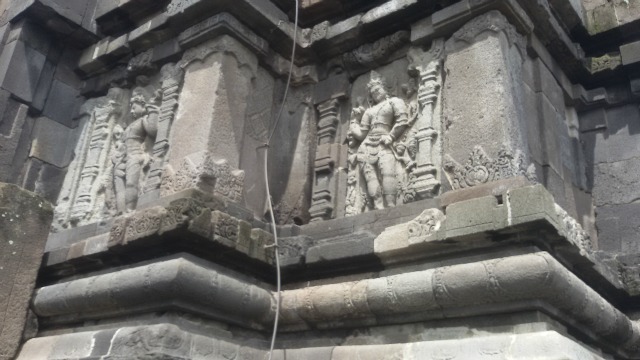
Reliefs on the temple wall

The main chamber :
A 3 meter high, 4- armed Shiv, or Siwa as he is known in Indonesia, stands on a lotus over a yoni supported by a naag (serpent), on the north side of pedestal.


It is very dark inside and taking a picture was a daunting task.
He has a crecent moon on his head (Chandrakapala), a crown of tousled hair ( jatamukuta), third eye on his forehead (trinetra). He holds prayer beads (aksamala),  a trident (trishul).

   Shiva standing on a lotus                                      Shiva yoni supported by a Naag head

Shiv's standing on a lotus is considered as the intermingling of Hinduism and Buddhism.
Some historians believe that Lord Shiva is a depiction of King Balitung. 
This practice of personification of King in a God or Devraaja has been common practice in South-East Asia.
In Angkor Wat, the huge Vishnu is said to be King Jayavarman VII.

Rishi or Sage Agatsya:
Moving in a clockwise direction from Shiva chamber is the temple of 
Sage Agatsya.


Sage Agastya

He was the teacher of Lord Shiva. He holds prayer beads in one hand and kamandal in the other. Kamandal is an oblong pot made of dried gourd or coconut shell used mainly by Hindu ascetics.

Lord Ganesha:
Ganesha, the son of Shiva and Parvati is seen sitting on a lotus in the west chamber.


Lord Ganesha

He is the obstacle remover and full of wisdom. Here at the temple, the trunk is turned towards the left and into a bowl of sweets. This means that worshipping him will provide us material prosperity.

Durga as Mahisasurmardini:

Moving further towards North is goddess Durga depicted as Mahishasurmardini or the slayer of the demon Mahisasur. The 8-armed deity holds a weapon in each arm which were given to her by gods to slay the demon.

It is said that there is a likeness between the Rakai Pikatan's wife Pramodhawardhani and the deity Durga. Pramodhawardhani later got Candi Plaosan constructed which is just a few kilometers away from this temple.


Goddess Durga

Lord Vishnu gave his Sudarshan Chakra, Shiva gave her his trident (trishul), Indra gave his thunderbolt (vajra). Other than this she holds a conch, bow and arrow, sword, lotus. In the top right hand, she does not hold anything and blesses her devotees.

Mahisasur was both a buffalo and a demon, that is why in the above picture you see Durga's victory over the buffalo by standing on top of him and that of demon by holding him by his hair.

Nandi temple or Candi Nandi:
How can Nandi not be present where his master is? Nandi is not only the mount of Shiva but also his ardent devotee. He sits outside the temple waiting for his master's orders.

Candi Nandi facing Shiva temple

The retoration of this temple was completed  in 2009 afterit was damaged by an earthquake in 2006. Behind Candi Nandi, you can a Kelir temple. This west facing temple is 15x15 square meters and is 25 meters high.
The panel at the base of the temple are clearly visible.

Nandi

The single chamber is occupied by a huge monolith sitting Nandi.

Nandi sits inside the temple with Chandra (moon)  and Surya (sun) at the back

Behind Nandi, there are two idols. On the right side is Chandra and to the left of Nandi is Surya.


Chandra, the Moon god stands on a carriage pulled by 10 horses. He holds special significance as Lord Shiva holds moon or Chandra on his head.


Surya or the Sun god also stands on a carriage drawn by 7 horses. He holds a lotus in his hands.

reliefs on outside temple wall

more reliefs

After coming down, I turn to the temple of Vishnu and then go to the right of Shiva temple to see the Brahma temple.

I continue to next post on Candi Vishnu and Candi Brahma, Candi Vishnu and Candi Brahma, Prambanan temple


Monday, February 15, 2016

Candi Prambanan, Yogyakarta

A half an hour drive from Yogyakarta commonly called Yogya, Yogja, Jogjakarta, Djog-ja leads to the most beautiful and biggest Hindu temples in Indonesia, the Prambanan temple locally known as Candi Roro Jhonggrang or the  Temple of the Slender Virgin.

Yogyakarta is the cultural hub of Indonesia with multitude temples in its fold. The beauty of Prambanan temple welcomes as you set your eyes on it. One cannot stop a gasp of admiration at the sight of these tall, slender and ethereal temples.

Built during the 9th century, this "Trimurti" is dedicated to the three trinities in Hinduism, Brahma, the creator, Vishnu or Wisnu, the preserver and Shiva the destroyer and is a collection of 240 Hindu temples. Prambanan comes from Parbrahma (परब्रम्ह), meaning the "The Supreme Almighty".


Few facts about Prambanan:

  • Prambanan is a temple with a unique Mandala (a diagramatic representation of universe) layout.
  • It is believed that Hinduism in the form of Shaktism was brought to Java and Bali by Rishi Markandeya. Durga, in her fierce manifestation, is worshipped as Chandi or Chandika. 
  • In Javanese, Candi refers to a structure based on Indian type of shrine. The word Candi comes from Chandika, written as Candi but pronounced "Chandi".
  • The 224 Perwara temples are based on the number associated with the Goddess in Sri Yantra or Sri Chakra.
  • Sri Yantra is a sort of diagram drawn with nine interlocking triangles around a central dot or bindu.
  • There are the four rows of concentric triangles in a Sri Yantra and these Perwara temples denote that number in this temple layout.
  • It is said that the inner courtyard used to be flooded with water to represent Kshir Sagar  (क्षीरसागर) or the Sea of Eternity.
  • One fascinating thing to note in the dimensions is that the total of the heights of Candi Vishnu (33 meters) and one Candi Perwara (14 meters) equals to the height of Shiv temple which is 47 meters!
It was built in the 8th century during the Sanjaya dynasty by Rakai Pikatan. The first glimpse of this majestic temple reminds one of Angkor Wat in Cambodia. The reason can be said to be very simple. The Pallava kingdom flourished in India during the 6th to 9th century and it very strongly influenced the architecture in the surrounding countries.

As you near the temples then do you realize that both temples are very different from each other.

                  Angkor Wat                                          Prambanan temple

All temples in Java and Bali are made of volcanic rocks. Merapi, the active volcano here, has been spurting out lava for a long time. No doubt, the black rocks come from there. One can see the black soil everywhere. With lots of water and fertile land, the region of Java is full of lush green plants and trees.

           an architectural model kept inside the ticketing office                   temple layout

picture taken from borobudurpark.com

The above aerial picture will give a very nice perspective of the magnitude of the temple complex.

The temple is surrounded by a wall inside which lie a group of temples, most of them destroyed over a period of time.

  Temples as you get closer to them

side view of temple complex


 temples inside the inner courtyard

The above picture gives an idea of the magnitude of these temples. Straight ahead is one Apit temple and on the right side the Nandi temple.                                                        

Keeping in mind the temple plan, let me start from the outermost zone.
Perwara temples:
  • These 224 complementary temples were arranged in four concentric  rows the number decreasing from outer to the innner rows. The outermost row had 68 temples, the next having 60 temples and then another row having 52 temples and the innermost 44 temples. They were also considered as the guardian temples.
  • They are devoid of any idols.
  • Also, the temples were arranged on four descending terraces in such a way that the shortest temples were towards the outside getting higher and higher as they go inwards . The model above will give an idea about the layout of temples. Only two Perwara temples remain to be seen.
  • The dimensions of each temple is 6x6 square meters and have a height of 14 meters.

remaining Perwara temples

  a Perwara temple


rows of Perwara temples ruins

Once you enter the innermost compound which measures 110 x 110 meters, the sheer magnitude and grandeur of temples engulfs you.

This complex consists of 16 temples:
  • 3 temples dedicated to the holy trinity of Brahma, Shiva and Vishnu, all facing east
  • Vahana or mount temples : in front of each temple stand Hamsa or Angsa for Brahma, Nandi for Shiva and Garuda for Vishnu facing west or towards the Trinities. These are the mounts of each of these Gods.
  • 2 Apit temples stand facing North and South direction, flanking the row of temples.
  • 4 Kelir temples in the four cardinal directions, so one temple each in North, South, East and West. This conforms to the Sarvato bhadra style having entrances on all four sides with a Gopuram on top of the doors. Gopuram are small towers erected on top of these entrances.
  • 4 Patok temples in the four corners of the temple square.
Architecture of Prambanan temple:
The construction of this temple is based on Vastu Shastra which is the science of architecture and gives a lot of importance to the directions and patterns in a building. In India, even today, many of the houses and buildings are built following Vastu Shastra.

All temples have three zones:
the lowest Bhuloka (bhu means earth and loka is sphere) or Bhurloka, this comprises the world we live in bound by lust, desire and passions. It comprises of mountains, rivers, the world we share with plants and millions of living things.

above it the Bhuvarloka, which is represented by the area of temple occupied by ascetics, holy men.

finally the Swargaloka or Swarloka which is the abode of God and is the zone of pleasure. It is represented by the top most pinnacle a temple building. 

Prambanan panel:
On the lowermost zone, the temple wall is decorated with a row of small niches which has a lion flanked by two kalpavriksha or Kalptaru, the wish yielding tree.


The tree is flanked on either side with pairs of birds and kinnars and kinnari  who are mythical celestial being with legs and wings of bird and torso and head of humans. They are associated with music and are said to play for Gods.

tree flanked by deer

The panels might also have birds, deer, sheep, monkeys. This pattern of Kalpvriksha with animals of either side is typical of this temple and is commonly known as the "Prambanan panel".

rabbits on either side of tree

birds under Kalptaru

cranes and deer panel

Kaal and makar:
Kaal and makars are ubiquitously seen in the temples of Prambanan and also at Borobudur.
Makars are also seen on either side of stairs in a temple.

steps leading to a temple

Makar with a gana inside
Gana (गण) are attendants of Lord Shiva.

Makar with Goddess Lakshmi inside

Makars guard entry to the temple. They are mythical animals with head of a crocodile, an elephant trunk, eyes like a monkey, body is half mammal and half fish. They can be seen having jewels with a dwarf figure inside.


They also can be seen as a gargoyle or as a water spout as in the above picture.

Kaal on top of a gate

Known as Kaal or Mahakaal (महाकाल ), maha, great, kaal is time. The "Great time" has a ferocious face and signifies that time engulfs everything, with Mahakaal devouring  time itself. They can be seen as door keeepers. They are also called "Kaalmukh" ( kaal mouth)

Kaal-Makar gate

According to Hindu mythology, he was created by Lord Shiva to kill Daksha. 

Another version refers to it as the head of Rahu.  Rahu is one of the nine planets who drank a little of elixer after the churning of ocean. He was beheaded but since the elixer had already entered his head, he remains immortal. Kaal represents that head and therefore symbolizes the elixer of immortality which is shown by a string of jewels which hang from his upper jaw.

In the above picture Kaal is above on the gate and Makar is on the side walls.
Kaal is also considered a protective figure as it keeps the evils spirits away and these are seen on top of gate or door ways.

Kaal-makar are found in conjunction with each other.

Before the main sanctum, the balustrade is full of bas reliefs from Ramayana. There are so many that it is impossible to take pictures of all or post all of them here.

Bas reliefs in gallery:
All three temples are decorated with bas-reliefs narrating in detail the story of Ramayana and Mahabharata. The panels proceed in a clockwise direction. This movement also supports the circumambulation or pradikshana which a devotee performs while visiting a temple.

Devta flanked by Apsaras

Rishi ( a sage or saint) in Brahma temple

The Trinities:
The three temples are dedicated to the trinities in Hinduism. Brahma, the creator, Vishnu, the preservor and Shiva the destroyer.

           Lord Brahma                                         Lord Shiva                                  Lord Vishnu             
Vaahan temples:
Vaahan or mount of any God is always placed nearby. Usually these temples are not that elaborate and big but at Prambanan, the Vaahan temples too are quite large. Candi Nandi is seen in front of Shiva temple, Garuda in front of Vishnu and Angsa or Hamsa in front of Brahma. Instead of writing about Vaahan temples separately, I shall be writing about them along with their respective Gods.

 Garuda temple                                    Nandi temple                              Hamsa temple

Apit temples:
There are two Apit temples one on the North and the other on the South between rows of deity temples and Vaahan temples.  Apit means to flank and so did not serve any purpose.


These 6x6 meter square and 16 meters high flanking temples have just one entrance. They have a very small chamber but are devoid of any idols.


Kelir temples or Candi Kelir :
These  four cardinal direction temples stand in the inner compound. So, there are four temples one in each in North, South, East and the West.


The temples are 1.55 meter square X 1.55 meter square and are 4.10 meter in height. They do not have any entrance stairway or any idol inside. These temples probably functioned as guardian temples to ward off any evil spirits.


There is a small opening inside these temples. I do not know the significance nor do I know if there was any image placed on top.

Behind the C.Kelir in the picture above, you see one of the entrance or exit to the temple.

Candi Patok or Sudut :
In the four corners or between the two Candi Kelir temples are four Candi Patok or Candi Sudut. Sudut means corner.


They have the same dimensions as Candi Kelir and are 4.10 meter high with a base of 1.55 X 1.55 square meters. They like the Candi Kelir do not have any entrance stairway or any idol inside.

Prambanan Museum:
Before I start writing about the various temples in this complex, let me post some pictures of the state in which they were discovered. The museum while on the exit is a must see and has a collection of not only pictures but also the treasure excavated.


I shall place pictures of temples in the respective posts.

I am going to write about Candi  Shiva in my next post Candi Shiva, Prambanan temple

Saturday, February 6, 2016

Jakarta Gem Center

The one place where you see gems in mounds is Jakarta Gem Center. Located in East Jakarta, near the Jatinegara railway station, it is not at all a difficult place to reach.

The four floor building is famous for precious stones, semi-precious and also some rare stones which obviously fetch a very high price. The place opens at 7 am and closes around 4.30 pm. It is advisable to visit it on week days as weekends become very crowded. Plan your visit so that you can avoid Jakarta traffic.

I am a novice and have no idea what so ever of the gems. I had heard so much about it so I wanted to visit that place. But, I had never imagined the vast collection of gem stones there.
The place is easily accessible by taxi and it might drop you on the other side of the road. Climb the over bridge and cross to the other side.
Three large golden rings welcome visitors to the center.
close up of the rings
The air conditioned place has a huge hall with plenty of kiosks and small shops.
haggling for price
I had never seen so many colored gems. You think of a color and it is there!
Ready made rings are already there.  But, sometimes customers might not like what is on display so you buy the ring without a gem stone. You chose a stone of your liking and get it mounted on the ring.
all shades of color are available
Multi colored bead strings hang all over the place in bunches.
Huge blocks of gem ore
Gem "stones" and polished gems for sale.
There is a small corner to the side of the main hall on the ground floor. Once you have picked your gem stone and want to get it fixed to your chosen ring, go inside the room. There are many people who will grind the stone and fix it to your ring. Yes, you wait till he finishes.
On the second floor, is the gem research laboratory.

I understand that this place is a whole-sale market and attracts not only Indonesians but also people from Japan, China and Singapore.
Even if you don't plan to buy anything like me, it is a nice experience to visit the place.