Around half an hour drive passing through University of Chiang Mai leads you to the main road to Doi Suthep. On your left, you pass the zoo and aquarium. Also are many waterfalls enroute as Mae Sa falls, Huay Kaew falls, Monthanthan. The signs are clearly visible. It would be worth a visit to these waterfalls if you happen to travel during the rainy season. The road is quite good and in between you get glimpses of the city below.
Wat Phra That Doi Suthep is commonly referred to as Wat Doi Suthep.
Few facts about this wat:
There is a legend associated with this wat. It is said that a monk named Sumana Thera of Sri Lanka came to Sukhothai (an early kingdom in the north of Thailand). He dreamt of a relic believed to be the shoulder bone of Buddha in one of the pagoda. He found the relic. The ruler of Lanna Kingdom, King Kuena, a devout Buddhist invited him to Chiang Mai.
The monk stayed at Wat Suan Dok or Suan Dawg. It was decided to enshrine the relic at Wat Suan Dok. The bone when unpacked had split into two pieces. The smaller piece was enshrined in that wat but the larger piece was put on top of a white elephant in 1919 on Vesak Puja day letting him go free where ever he wanted.
Wat Phra That Doi Suthep is commonly referred to as Wat Doi Suthep.
Few facts about this wat:
- Doi is a Thai name for mountain and Suthep is name of the mountain. Built 3, 500 feet above sea level, this Thervada temple is very much revered by the people and attracts pilgrims specially during Vesak Bochea ( Gautam Buddha's birthday) and Magh Bochea ( day of the first sermon of Buddha at Sarnath)
- Phra That: holy relic of Buddha (bone) enshrined here. Thus giving wat its name -- Phra Thai Doi Suthep
- Built by King Kuena or Gue Na of Lanna dynasty in 1386, temple has undergone renovation and expansion over a period of years.
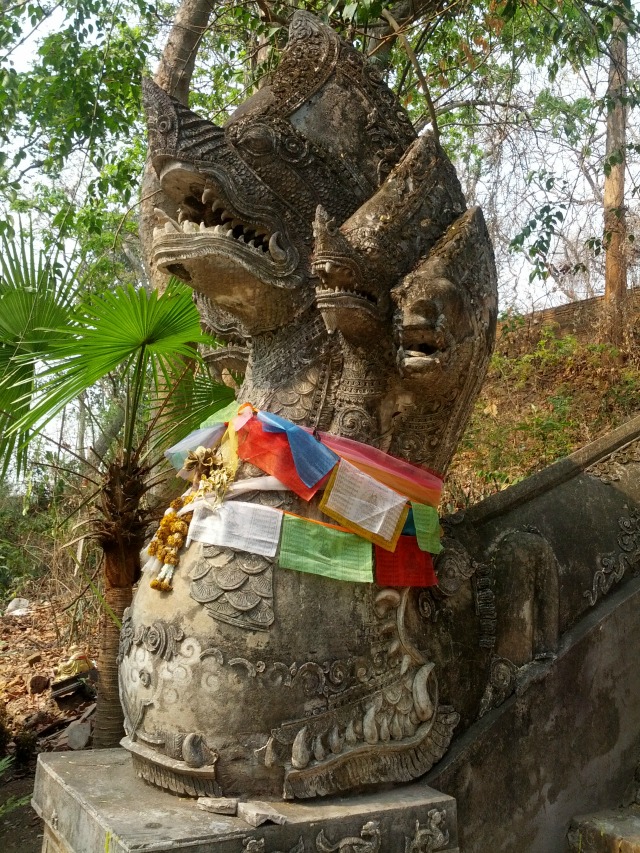
- The 700 year old , the 14th century Lanna style temple is reached by climbing 300 steps and has the longest naga balustrade in Thailand.
- there is a small fee of 30 Baht (0.90 $) for foreigners.
- close to this wat, further ahead is Bhuming palace which is a vacation place of the King and also a guest house for foreign dignatories and state guests. I could'nt go as it was closed that day.
There is a legend associated with this wat. It is said that a monk named Sumana Thera of Sri Lanka came to Sukhothai (an early kingdom in the north of Thailand). He dreamt of a relic believed to be the shoulder bone of Buddha in one of the pagoda. He found the relic. The ruler of Lanna Kingdom, King Kuena, a devout Buddhist invited him to Chiang Mai.
The monk stayed at Wat Suan Dok or Suan Dawg. It was decided to enshrine the relic at Wat Suan Dok. The bone when unpacked had split into two pieces. The smaller piece was enshrined in that wat but the larger piece was put on top of a white elephant in 1919 on Vesak Puja day letting him go free where ever he wanted.
The elephant climbed the mountain of Suthep reaching the place of wat, trumpeted thrice, fell down and died. This was considered as the a place for the wat to be built and enshrine the relic.

This is the place where all vehicles stop, make a U-turn to go back. If you are no mood to climb up 300 steps, go straight and take a cable car for a small fare of 50 baht ( around 15 cents). Thai residents do not need to pay for cable car or visiting the temple.


 As you start walking towards the wat, you are greeted with 306 steps flanked by bejewelled naga on both sides.


 bells surround outside the chedi wall


 information regarding the relic

 bronze statue of white elephant


 On the other side of this tree is an image of emaciated Buddha.


 paying respects in a viharn


Points of interest:

This is the place where all vehicles stop, make a U-turn to go back. If you are no mood to climb up 300 steps, go straight and take a cable car for a small fare of 50 baht ( around 15 cents). Thai residents do not need to pay for cable car or visiting the temple.

entrance to Wat
Foreigners pay for entry ticket on reaching the top.

Just on the right side of entrance is a golden statue of monk Phra Thep Worasittajan who was once the abbot of this wat.


close-up


entrance to wat

Keep climbing and as you near the entrance, a sign for foreigners is visible.

Dvaarpala or temple guardian on either side of entrance
 lions just before entrance

Once inside, before entering the chedi, go around the place in a clockwise direction.

Hor Rakhang or bell tower on the corner

ubosoth
Notice the wheel of Dharma behind the bell tower on both sides of entrance


Lord Ganesha

a terrible picture :(
Go straight ahead and you get to see a beautiful view of the city below, river Ping flowing with the backdrop of mountains. The farmers were burning their crop and this made the city full of haze all day.
a sign board outside the temple of white elephant

temple of white elephant guarded by MOM

temple of white elephant guarded by MOM
MOM is a northern Thai mythical fierce creature which looks like a big gecko and dragon with sharp jaws. It is a guardian creature and known as "Dtuwamaum". Commonly referred to as MOM. Not to be confused with mother!


inside the temple


wooden panel
Keep moving straight and under the tree named as the Bodhi tree, sits Buddha.
Buddha sits on a beautiful throne


people paying respect to the monk with whose efforts road to this wat was built in 1935

entrance to chedi with Ganesha on either side
Remember to take off your foot wear before entering inside towards the chedi.

images of Buddha behind which are murals depicting his life

In the center is the golden bell shaped 24 meters chedi in Lanna style which enshrines the holy relic (bone of Buddha).

Four such parasols stand on four corners of chedi which were added in the 16th century. Devotees make merit by sticking gold leaf to the shaft of these parasols.

replica of emerald Buddha ( original image is at Wat Phra Kaew in Bangkok)
 Buddha sits under a canopy of Muchalinda (the serpent)
 reclining Buddha


devotees offering holy water to chedi replica
The golden chedi is surrounded by viharns or wiharns which are places or halls where people come to pray. There can be one viharn in a wat or may have more with images of Buddha. They provide peace and solitude to devotees wishing to meditate.

Taking blessings from monk
 beautiful golden and silver Buddha images in one viharn
 another viharna


Devotees put oil in the lamps offering to Buddha in various asanas.

Sala tree
Also known as canon ball tree, this tree is important as Lord Buddha was born under a Sala tree in Lumbini on a full moon day in the month of Vishakha. A Ashoka pillar now stands today at the place of his birth in Lumbini.

flowers and nut of Sala tree
There are plenty of shops selling souvenirs as you come down.

birds in cages, they are released to gain merits
It is a good idea to have a drink of fresh coconut water or grab a small meal. Also some souvenirs one may chose to take back home.
Points of interest:
- Notice the longest makar balustrade as you climb up the 306 steps.
- beautifully decorated dvaarpalas before entrance.
- golden parasols on four corners of chedi
- replica of emerald Buddha
- temple of white elephant
- Bodhi tree under which sit Lord Buddha
- fine architecture depicting Lanna style
- view from the rear side of temple
- temple hours: 5:30am - 7:30pm,
- small entry fee for foreigners
Wat Sri Suphan, Chiang mai, Wat Chedi Luang, Chiang Mai, Wat Umong, Chiang Mai, Thailand, Wat Jed Yod or Ched Yod, Wat Phra Singh, Wat Chiang Mun, Chiang Mai, Thailand, Wat Suan Dok Mai